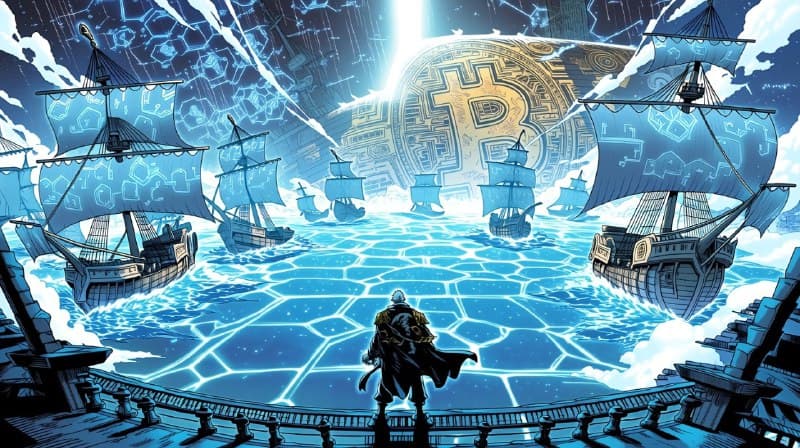
The two expressions look like nothing more than a reversal of word order. But they contain entirely different blueprints for finance. Tokenized securities are closer to putting an existing securities train onto a new track. Security tokens mean laying the track first so anything can run on it, and seeing securities as just one of the many assets that can ride on top.
First, we need to look precisely at the term STO. STO stands for Security Token Offering. It is the act of issuing and selling security tokens. Just as an IPO is not another name for a stock, an STO is not the name of an asset. The asset is the Security Token, and the act of issuing it is the STO. In Korea, the two have become mixed together, and STO has incorrectly settled in as the name of an asset class itself. This is plainly a misnomer.
The term that emerged first in global markets was Security Token. Literally, it means “a token with the characteristics of a security.” By contrast, moving an existing stock or bond into token form is called a Tokenized Security. In the real market, the two expressions are somewhat mixed and used interchangeably, but they start from different places. One starts with the token and asks about the legal nature of the rights contained in it. The other starts with something that is already a security and asks how to turn it into a token.
This difference is not just about translation. In “tokenized security,” the security is the substance and the token is new packaging. In “security token,” the token is the basic unit that carries and moves rights, while the security is a legal attribute carried inside it. The moment you reverse the order, what you fix and what you redesign also change.
Tokens do not just carry stocks and bonds. Rights as different as claims on deposits, ownership and income rights in real estate, proceeds from electricity sales, and carbon reduction credits can be represented in the same digital format. The laws and responsibilities applied to each asset may differ, but a machine can read who owns it, under what conditions it can be transferred, and when money is to be paid.
The current system in Korea is closer to adding a single token-only branch next to the existing rail network. Securities are recorded on a distributed ledger, but money moves through the banking network. Investor verification and custody remain in each company’s system, while dividends are processed in yet another ledger. Once a trade is complete, the central securities depository, banks, securities firms, and custodians have to reconcile their numbers again. It is like laying new track while people still handle the transfers, with only one more timetable to check.
What tokens can change is not the appearance of securities but the grammar of transactions. If ownership, transfer conditions, and payment conditions are bundled into one unit, the movement of an asset and the movement of money can be made to interlock within the same transaction. Rules can travel with the asset: only approved investors can buy it, transfers can be blocked if the collateral ratio falls apart, and proceeds can be divided according to an agreed ratio when they come in. This does not just digitize ownership. It moves the promises attached to ownership along with it.
Think of a solar power plant. Today, tokenization often ends with dividing ownership in the plant into small pieces and selling them. If the token rails are properly laid, generation data, electricity sales proceeds, loan collateral terms, and investors’ dividend rights can all be connected in a single transaction flow. The process by which sunlight becomes electricity, electricity becomes revenue, and revenue is divided into repayment and dividends can continue within the same structure.
After that, the entire life of an asset changes. A right issued when the plant is built can become an income right after completion, its collateral value can be adjusted according to electricity sales performance, and the process can continue through the final settlement when the equipment is sold. Today, these are events scattered across contracts, bank accounts, generation data, and shareholder registries. Tokens do not mix these events together. They connect them without breaking the chain.
Of course, a generation figure does not become true just because it is written into a ledger. A sensor can be wrong, and a verifier can make a bad judgment. Someone can lose a private key, or code can behave differently than expected. So we have to design, together, who checks external data, who stops transactions, and how wrongly paid money will be reversed and compensated. Tokenization does not eliminate responsibility. It reveals where responsibility had been hidden.
Money also needs to get on the same rails. If an asset changes hands immediately but the payment travels through the banking network and arrives hours or days later, settlement risk remains. Whether it is tokenized deposits or another digital means of payment, it must be possible to exchange the asset and money at the same time. More important than the size of the token issuance is whether the asset and money move together in one step.
If each institution builds a closed ledger, old partitions will come back to life on the blockchain. If investor eligibility and transfer restrictions confirmed on one ledger disappear when they cross over to another, and screening and recordkeeping have to be repeated every time, it is difficult to call that a connected financial system. Before asking about processing speed, we should ask whether rights and regulatory information remain intact as they cross between ledgers.
A common rail does not mean that every asset is governed by the same law. Voting rights in stocks, redemption claims in bonds, and claims for the return of deposits must remain different. Just because the cargo on a train is different does not mean we need to build a new track gauge and signaling system every time. What should be designed in common is a way for records, transfers, settlement, identity verification, and accident recovery to work together.
The role of financial institutions could also change here. Today, power comes from who holds and records the ledger. On token rails, what matters more is who sets the standards, connects to other networks, presses the stop button in an accident, and approves recovery. This is less a future in which banks, securities firms, exchanges, and custodians disappear than one in which the functions and responsibilities they once held together are divided up again.
Competition in the market could also shift from the number of issuances to connectivity. The stronger track is not the one built by the company that makes the most trains, but the one that reaches many stations without transfers. Liquidity is likely to gather around networks that connect more assets and means of payment, as well as investor identities and regulatory information. In the age of tokenization, the strategic asset may not be the number of tokens but the standard that carries different rights without interruption.
That is why regulation should not begin with a list of “which securities will be allowed to become tokens.” It should first decide how far the law will recognize ledger records, how assets and money will be moved at the same time, how rights will continue across networks, and who will stop, recover, and compensate in the event of an accident. The task is not to add one more token section to the existing system. It is to set the specifications for the rails on which the finance of the future will run.
The person who sets the standard is not choosing a single word. They are deciding what assets can enter in the future, whom they can connect with, and where they can stop. If we first lay a track narrow enough for securities to barely pass through, rights tied to real estate, deposits, energy, and carbon will require another track. If we create a common standard from the beginning on which multiple assets can run together, securities can become the first cargo to be regulated on it.
The test is simple. If you remove the token and the institution’s work sequence and ledger reconciliation remain exactly the same, then all that changed was the way the security is represented. Finance can be said to have changed tracks only when the asset and money, transfer conditions, and responsibility for accidents all move together within one transaction structure.
That is why “security token” is more important than “tokenized security.” It is not a matter of translation preference. It is a forward-looking vision of redesigning all of finance by using the token as a vessel that moves without friction on the blockchain’s globally common rails, rather than simply adding tokens to existing securities.