One morning, my wallet app is awake before I am.
Overnight, the refrigerator orders more milk, my work AI pays the server bill, and the car pays for charging. Thirteen transactions are done before I open my eyes. Won has left my salary account, but the milk seller has received dollar stablecoins, and the server company has been paid in a machine payment unit whose name I don't even know. All I see are green check marks.

Payment complete.
I open the settings. The wallet updated overnight. At the very bottom is a line of small print.
‘We automatically select the best currency for faster, cheaper payments.’
My balance is still displayed in won. My salary came in as won, and my apartment loan is still in won. The ₩ on my tax bill is plain to see. But as I scroll through the wallet's transaction history, the won appears only at the starting point. It turns into dollars the moment it crosses a border and disappears behind the screen when machines settle with one another. The won has not died. It just no longer leaves the house.
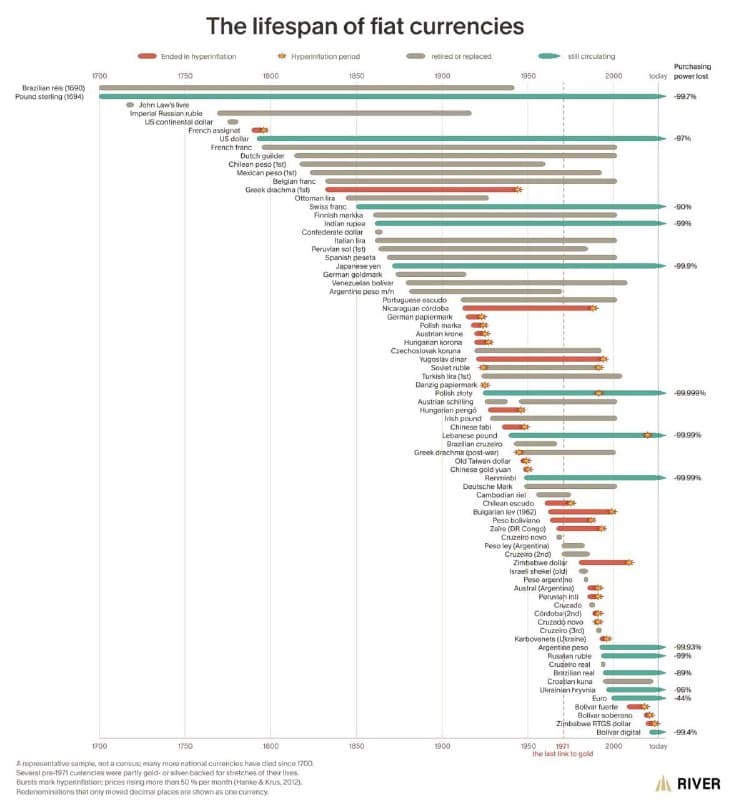
What led me to imagine this scene was an image I saw online. It said the average lifespan of a fiat currency was 27 years. It also said that of 775 currencies in history, 599 had disappeared, and that the median lifespan was 15 years.
The numbers were specific. I thought there must be an original source somewhere, so I went looking. The trail did not begin with the IMF or the World Bank. It began with 「Fate of Paper Money」, an article Mike Hewitt posted on a site called DollarDaze in 2008. The site is gone, and only the article remains in the Internet Archive. A site that collected currency obituaries had closed its doors before the currencies did.
When I opened the original, its numbers differed from those in the image. Calculating directly from the table gave me an average of about 38.5 years and a median of 17. I could not get the 27 and 15 shown in the image.
That does not mean the table's contents are false. Colonial money, money issued by armies, and money from before and after currency reforms are all mixed together. Money abandoned because of runaway inflation and the German mark, replaced by the euro, were both counted as dead. The mark was less a death than a name change and a move to a bigger house.
Currencies still alive were left out of the calculation. The won and the dollar did not yet have an end date. If you average only currencies that have ended, the ones that last a long time never make the list. This table is less a record of currency lifespans than a record of the traces left by war, independence, and the breakup and unification of nations.
So 27 is not a reliable figure for the “average lifespan of a fiat currency.” But it did remind me that the won I use is an institution created at some point, and that it may not last forever. Counting from the currency reform of 1962, today's won turns sixty-four this year. When, then, will its last day come?
A currency does not die one day like a heart stopping. It will die slowly as the jobs it once did are taken away one by one.
The won is strong only inside Korea. Salaries and taxes, apartment loans, company books, and government budgets are all tied to it. Fifty million people use the same unit for their daily lives and contracts. Even if the rest of the world does not accumulate won, this network keeps it alive. A small country's money can last a long time within such a network. That is why a currency's lifespan is hard to explain through national power alone.
The problem is that a different world opens up as soon as you cross the border. In 2024, 84.5% of Korea's export payments and 80.3% of its import payments were settled in dollars. The won's shares were about 3% and 6%. Even when the goods being sold are made by Korean companies, the invoices are written in dollars. The won is the language of the home, and the dollar is the language of the port.
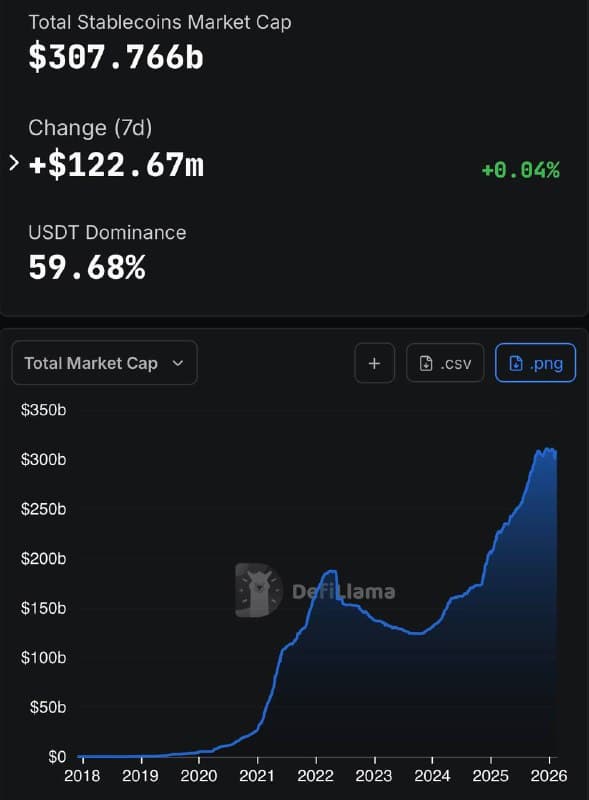
If the world's borders grow taller again, the won's house may become sturdier for a while. Tariffs, subsidies, and domestically focused supply chains can help hold the domestic currency's role in place. But the higher the walls, the more people look for cracks rather than doors. When sending money becomes slow and expensive, stablecoins that track the dollar's value can become a detour inside a phone. The state builds walls to keep the dollar out, but the dollar shrinks itself and slips into a wallet app.
Before long, a small foreign exchange market opens inside people's wallets. Salaries in won, savings in dollars, overseas services paid for in stablecoins. Their address is in Seoul, but they live in three currency zones. At first, only the payment currency changes. Then the price tags change. After that, the calculator in their heads changes. Even if I earn my salary in won, I value my time in dollars and compare home prices and investment returns in dollars. The moment a currency is displaced is not the day we throw away its banknotes. It is the day we first think of the value of our future in another currency.
With AI, this change becomes quieter and faster. Until now, laws have not been the only thing protecting small countries' money. People look at prices in familiar units and spend the money they earn as it is because exchanging it is a hassle. This small inertia is a breakwater for a country's currency.
But an AI making payments within the limits its user has allowed has no patriotism, hometown, or habits. It compares fees, exchange rates, and processing times to choose the most favorable route. A thinly traded currency costs more to exchange and is accepted in fewer places. So AI chooses it less often, which means even less trading, which makes it more expensive again. A loop can form. A small country's money could be pushed behind the payment screen far faster than in the days when people opened their wallets themselves.
A person may think they bought something in won, while the seller receives dollars. How many currency exchanges took place gets pushed into the small print at the bottom of the receipt. In a market where machines buy and sell server capacity, data, electricity, and advertising from one another, the familiar faces on banknotes do not matter either. All they need is money that can be called up at any time, divided into tiny amounts, and settled automatically. The unit people count their salaries in may diverge from the unit machines prefer to use.
At that point, currency competition moves outside the central bank building. What matters is which money connects to an API first, appears on the wallet's home screen, or becomes the default on the payment button.
The state can collect taxes in won. But it cannot make every machine beyond its borders reach for won first. The won will remain on tax bills and pay stubs for a long time. But if savings and international transactions leave, and even machines no longer call on it, the won will shrink while still alive. By the calendar, it is a long-lived currency, but it has less to do.
So the currency obituaries to come may have no date of death. Price tags leave first, savings follow, and finally machines forget the currency's name. No one will hold a funeral.
And one morning, the wallet app will quietly update.
Your default payment currency has changed.