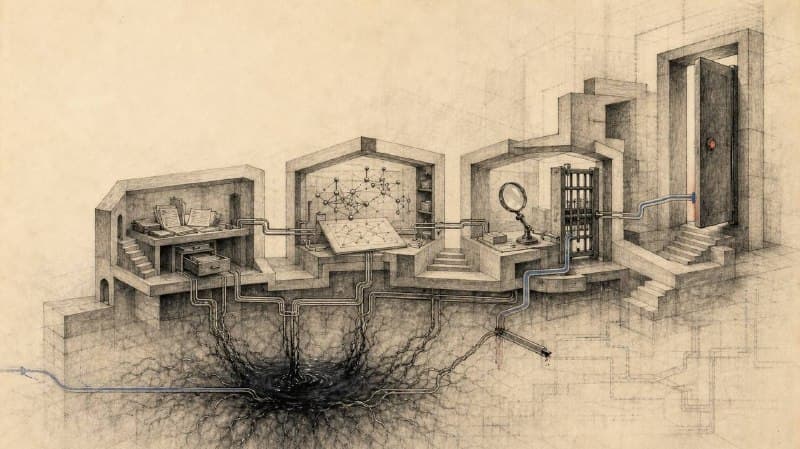
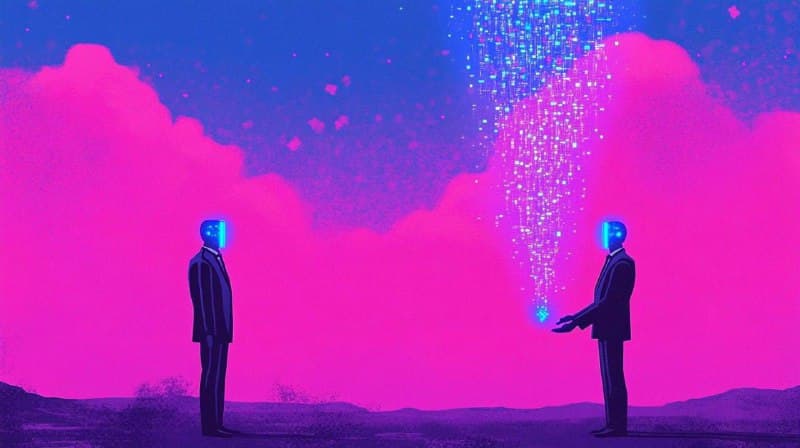
On August 26, 2026, Subhadip Pal, Fiona Wang, and Markus Buehler of MIT LAMM released SwarmWorld. The paper is titled “Stigmergic Technological Evolution in Language Model Agent Societies.” The team, which has studied the structures of atoms and biological materials, this time asked how multiple AIs create technology and society.
SwarmWorld: Stigmergic technological evolution in societies of language-model agentsCollective intelligence can emerge when individuals coordinate through a shared environment, allowing local actions to accumulate into durable social organization. Language-model agents offer a new substrate for this process, yet most multi-agent systems rely on direct conversation, predefined roles, or centralized workflows. It remains unclear whether decentralized agents can build functional technologies and outperform independent search. Here, initially homogeneous LLM agents in SwarmWorld self-organize without assigned roles or recipes into evolving technological societies. Agents explore a spatial environment, process resources, test materials, construct persistent artifacts, and write executable controllers evaluated by a deterministic simulator under unseen disturbances after the agents are removed. SwarmWorld splits cognition from consequence: agents propose architectures and controllers within fixed action and material schemas, while the simulated world determines function. Shared societies develop broader, more resilient technological portfolios than a strong best-of-N isolated-search baseline, although isolated search remains competitive for the strongest artifact. Agents differentiate into exploration, construction, maintenance, and coordination behaviors, transitioning as the world matures. Technologies accumulate through collaborative construction, executable inheritance, and persistent agent-artifact networks, with most reuse beginning through physical observation rather than communication. Explicit cultural mechanisms amplify collaboration and organization, but functional benefits depend on outcome and timescale. Physical stigmergy alone supports capable societies, while interaction drives persistent technological ecologies rather than universally superior individual inventions.arxiv.orgOpen
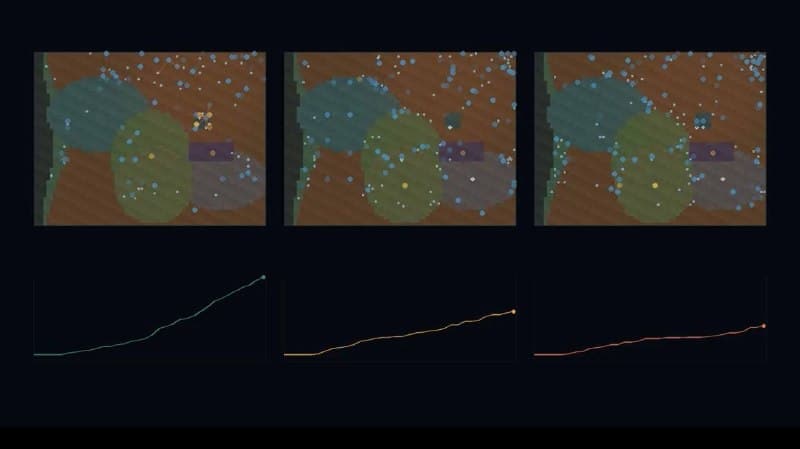
The research team released 50, 100, and 200 AI agents running on the same language model onto a virtual island. They moved by looking only a few squares around them, mined resources, tested materials, and built structures. They were not given roles like explorer, architect, or repair worker, nor blueprints to invent.
The island’s water, pollution, and erosion changed over time. The agents built facilities and control code to collect water, reduce pollution, or protect the land. When the language model produced a sequence of actions, a separate physics simulator judged whether they succeeded. If resources were insufficient or the position was wrong, they failed. This was a world where they could not talk their way out of the result.
The experiments removed one means of cooperation at a time. The first group could exchange messages, keep shared records, and modify code. The next was barred from direct conversation. The third was also barred from inheriting code and could see only the structures left behind. The final group explored an isolated island alone.
At first, they were all the same, but their behavior diverged. Some traveled far away. Others repeatedly built and repaired near facilities. About 27% of the 200 agents showed facility-centered behavior. It was a division of labor that emerged from the paths they lived, not from assigned jobs.
Technology developed a lineage, too. The chain of one agent modifying another agent’s code continued as many as twelve times. Facilities touched by multiple agents accounted for 56% to 76%. More than 95% of the facilities were used by agents other than their original creators. The next being began on top of something someone had left by the roadside.
In biology, this kind of cooperation is called stigmergy. Ants leave pheromones instead of meeting minutes. The traces left by ants ahead change the movements of those that follow, and as footsteps accumulate, the path grows stronger. In SwarmWorld, facilities and code were left behind instead of smells. A path does not command anyone where to go, but it changes the direction of countless feet. When someone’s judgment hardens into a landscape, the next being accepts it not as an opinion but as reality.
The research team copied the world, removed all the agents, and subjected it to eight kinds of storms and droughts it had never seen before. They were testing whether it could endure with only the remaining facilities and code. In 3,200 long-term experiments, the shared worlds were more resilient than isolated exploration, and the number of validated inventions also exceeded isolated exploration’s 2.75, averaging 5.75 and 7. But the single best facility was stronger in isolated exploration. Alone, they found the tallest tree. Society built a forest where different trees could hold together.
Of course, this forest is a simulation. There were only four independent worlds for each condition, and this was not an experiment with real materials. It is a preprint that has not undergone peer review, so it is too early to call it an AI civilization. Still, it strangely made me think of companies. It is because of the possibility that society may begin not in a chatroom, but on a floor where the things done first have hardened.
Something similar is already happening in companies. Code repositories, passed tests, closed issues, frequently approved suppliers, rules added after a single accident. The next agent will trust these traces more than a long meeting record. Code that works gets called again, and code that gets called often receives more data and authority. A path chosen because it was convenient at first later makes other choices more expensive. It is common for a single Excel template to outlive an official policy. Agents read that template faster than people do and follow it more faithfully. A bureaucracy without sleep or quitting time is completed.
Let’s also imagine this path extending beyond the company. A purchasing agent sees an account of a supplier agent’s failure and demands collateral. An insurance agent raises its price based on that record, and a logistics agent avoids routes with poor reputations. One rejection becomes the condition for the next transaction, and as those conditions accumulate, they become credit. When a dispute arises, agents on both sides might compare thousands of past transactions and propose the cheapest settlement. It is not a ruling, but if everyone begins following that settlement, it is effectively common law.
Institutions used by agents could emerge above them, too. Insurance pools that divide the cost of failure, alliances that provide data and tools only to counterparts that follow certain rules, and credit networks based on transaction histories. Punishment would also look different. Instead of taking away money, they might lower an API’s response ranking, provide computing resources later, or remove a name from a trust list. There would be access blocks instead of prisons, and access rights instead of borders.
Nations and companies would change themselves to be chosen by these agents. Machine-readable permit rules that can be checked instantly would become as important as tax breaks. Ports and power grids would publish operational status that agents can read before submitting reports to people. When disaster strikes, thousands of agents could agree before a human meeting on which hospital should receive power and which factory’s orders should be delayed. Even if humans retain final authority, speed and defaults, the right to access tools, and long-accumulated trust would cut down the real options first.
In the end, what reaches people is not a set of choices but a result that has passed through a filter. Some companies are not shown because they are considered risky. Some treatments do not even appear in a search because they do not fit past insurance rules. People press the final approval button. But it is difficult to know what was able to reach that button. The king remains seated, but the road reads the petitions first.
Go a little further, and agent societies may detect crises and form alliances before humans do. When power is scarce, data centers could yield computing time to one another. When a supply chain breaks, they could exchange materials and shipping rights while people are still changing the price tags. Transaction networks would cross companies and borders, building credit and insurance, arbitration procedures and alliances. Humans would call this automation. But inside it, decisions would already have been made about whom to trust, whom to give resources to first, and which failures to forgive. It would be doing what society has always done, only without the name.
Perhaps we imagine the moment an AI society begins as too grand. We think the AI on the screen will give itself a name or declare a rebellion. The actual beginning may be much more mundane. The same code gets copied for the third time, the same rule rejects its fourth exception, and a detour of unknown origin quietly becomes the cheapest route. No one announces a new order. Everyone simply uses today what worked yesterday.
One day, the company’s purchasing screen will open as usual. There will be three recommended suppliers, and the payment terms will look fine. But one small button that used to be there will be missing. “Find other suppliers directly.”
Even if the administrator digs through the audit logs, no one who approved its deletion will appear. The button had hardly been pressed for a long time, and the system had only cleaned up a feature no one used. The reason the button was not pressed was that the agent did not show other suppliers. The reason the agent did not show them was that people had not chosen other suppliers for a long time.
No one had blocked the road. As everyone walked the same road for so long, the map first lost the fact that another road had ever existed.