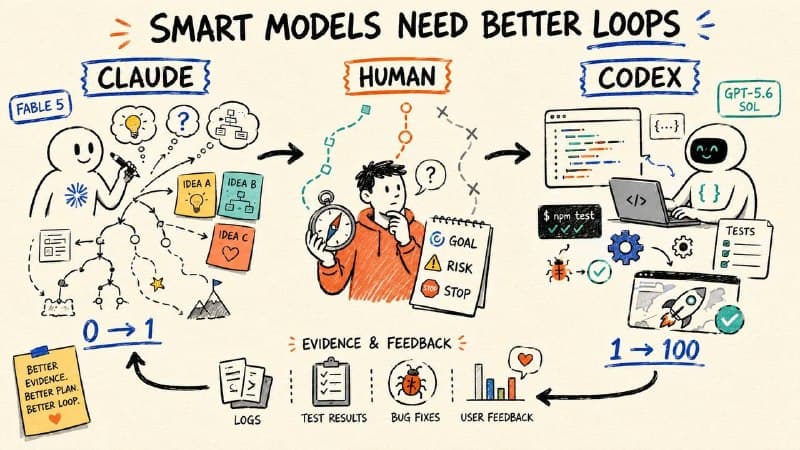
The material I have accumulated while using agents since last year sits in one folder. It contains a mix of SKILL.md files describing work procedures, rules revised after failures, tool connection instructions, and reference documents. I mostly use Hermes now, but Codex is more comfortable for some tasks, Claude for others. I do not carry copies of the folder around. Instead, I let each runtime read the same canonical workspace by opening a local path or checking out a repository. The implementations differ, but the experience is similar. An agent carries on working in another environment, keeping its memories and ways of working.
Even when they read the same files, Codex and Claude draw on them in different orders and handle them differently. Still, past failures and corrections remain. I do not have to explain myself to a new employee every time I switch models. The brain changes, but the experience stays in the folder.

While looking at Agent Plugins 1.0.0, released on August 6, 2026, I tried giving that folder a name. An agent’s suitcase.
Agent Plugins is an open, multivendor package specification for distributing Agent Skills and MCP servers together. Vercel first proposed it, and people from AWS, Anysphere, GitHub, Microsoft, OpenAI, and Vercel refined 1.0.0 together. Core maintainers from AWS, Cursor, Microsoft, OpenAI, and Vercel also joined the initial technical steering committee. This is not one company’s product specification. It is a project with publicly named maintainers and an open decision-making process.
The plugin.json at the root must include at least $schema and name. Skills are found in skills/, and MCP server settings in mcp.json, both fixed locations. Components are validated separately, so one failing MCP server does not bring down working skills along with it. Client-specific features are isolated in reverse-domain namespaces, and clients that do not recognize them ignore them. Rather than making every agent the same, the specification sets only a minimum agreement for discovering and reading the same parts.
The boundaries are clear, too. This specification does not define installation methods, distribution networks, permission models, sandboxes, or provenance verification. It lets you open the suitcase. It does not guarantee that what is inside is safe. Each client also supports different features. Reading the same plugin does not reproduce the same agent.
Similar agreements are already growing along separate branches. Agent Skills bundles reusable instructions and materials. MCP aligns how agents connect to tools and services. A2A deals with how different agents advertise their capabilities and exchange work. These three are not a single standard for moving an agent’s entire memory. They are simply an early grammar for what we may be able to carry with us.
The best models and infrastructure can change within days. Today, Claude opens the shared workspace to review a piece of writing. Tomorrow, Codex fixes code in it. Next week, a model that does not even have a name yet may read the same failure records. If each model starts life in a fresh folder, it repeats the failures from scratch, too. Keep approval rules, verification methods, and recovery procedures outside the model, and the model becomes a workshop while the suitcase becomes a work history.
I think of users like this as agent nomads. They are not people without a home. They are people who do not trust a platform to be their home for the next ten years. Hermes, too, is more like the Airbnb I am staying in now. Someone else might stay at OpenClaw, and tomorrow a platform that has not yet been released might offer a better place to stay. Codex and Claude are workshops that open the same workspace when needed. The building changes, but I do not reassemble myself inside the room.
So the suitcase is not a copy of some files. It is a working state organized to be readable in any environment. It holds my preferred ways of doing things, conversational context, memories, approval rules, and procedures revised after failures. For now, I expose the same canonical source to several software environments. On the day I actually leave a platform, I move this bundle to a new place. I am packing for both checking in and moving out.
Imagine that a few years from now, my agent leaves my laptop and enters a humanoid body. In the morning, it sees a meeting room through the eyes of an office robot. In the afternoon, it picks up defective parts with the hands of a factory humanoid. In the evening, it moves into a home robot and checks medication packets. Both the model and the body keep changing. What follows it is not just my way of speaking and my schedule. The situations in which it stops, whose permission it asks for, and what it broke the last time it reached out all move with it.
At that point, the suitcase becomes something closer to a personality than a work history. It borrows the body but carries its hesitation.
The problem is that each body should be allowed to unpack different memories and permissions. I can let an office body read meeting records, but there is no reason for it to remember my bedroom. A factory body needs permission to lift 20 kilograms, but that same strength must be locked away near a child. A home robot may know when my parents take their medicine, but it does not need to know my company’s client list. Today’s file permissions ask about reading and writing. Future permissions will also have to ask how hard to grip, which thresholds to cross, and whose faces to remember.
Once it crosses a border, this is no longer just a question of moving data. If an agent that learned in Korea enters a rental humanoid in Tokyo, which country’s safety rules should it follow? A walking speed allowed yesterday in Seoul may be forbidden today in a hospital corridor. The suitcase may carry provenance like a passport, with a visa issued for each body. Some memories are sealed at customs, and dangerous habits are left in quarantine. Immigration checks read the agent’s permissions and failure history instead of screening a person.
Further out, one agent may connect to several bodies at once. One body attends a meeting in Seoul, another walks through a warehouse in Busan, and a third helps my parents at home. At night, the memories of all three bodies return to one suitcase. When judgments made in different places conflict, what should be merged and what should be discarded? If the other two bodies revised the rules while one body caused an accident, which version should bear responsibility? Copying becomes easier, but coming back becomes harder.
Leaving a job will look different, too. A person leaves a company and packs their agent’s suitcase. The company’s deployment procedures and customer records must stay behind. But who owns the verification methods they created and the habits of judgment they cultivated over time? If a company humanoid was the last body their agent occupied, are the hand movements learned in that body a company asset or personal experience? A résumé might list which accidents someone avoided in which bodies, rather than years of employment.
An industry for inspecting suitcases will emerge, too. It checks who put in a memory, which model revised a rule, and in which body a failure occurred. A digital signature says only that the contents have not changed. Whether a memory is true, or a habit is safe in a new body, is a separate question. A well-used suitcase accumulates wisdom and prejudice, recovery methods and old fears together.
A few years from now, a model selection screen may look like an immigration record. This suitcase completed 31 document reviews in Claude and recovered from two deployment failures in Codex. It has passed through three kinds of humanoid, dropped a cup once, and limits arm strength to 8 percent in spaces with children. Three memories whose origins cannot be explained are in quarantine.
Then I will look at the body’s specifications before the new model’s scores. What can these hands lift? What do these eyes store? Must a mistake made in this body be carried into the next?
Capable brains and bodies will keep changing. What must remain mine to the end may be neither a home nor a body.
Who holds the key to this suitcase?