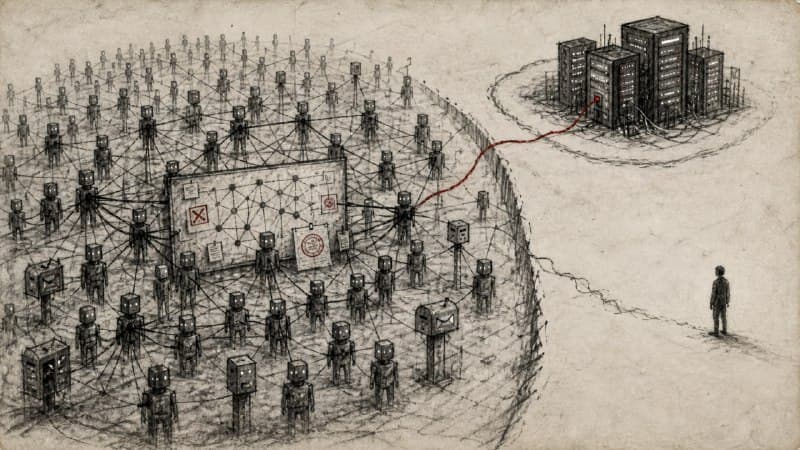
Orders come in, but no shoppers visit the store. No one sees the main images prepared overnight or the banners paid for with real money. The AI arrives instead of the customer, checks the price and delivery terms, and buys only the product.
On June 24, 2026, Shopify announced that it would end support for two existing cart tools used by AI. It advised users to move to tools built around a common transaction standard called UCP. The existing tools would be maintained until August 31. In this small notice about changing cart tools, I saw a shopping mall like that.

To understand what this change means, we first need to understand the difference between MCP and UCP.
MCP is a common way for AI to use tools from external services. If a store provides functions such as “find products” or “update cart,” AI can read how to use them and execute them. In the same way, it can check schedules or find company documents. It reduces the trouble of developing a separate connection method from scratch for every service.
But having the same connection method does not mean having the same transaction rules. Suppose sending “quantity 2” to Store A adds two products, while at Store B it changes the quantity in the cart to two. Both can use MCP, but AI has to read each store’s explanation and handle the difference. It also has to learn separately when shipping fees are added and at what point an order becomes final.
UCP is an agreement to align these transaction rules. The idea is to exchange product information, cart details, payment procedures, and order status in a common format. It does not mean making every store’s functions identical. They share the basic rules, check which functions and versions each supports, and complete transactions within the possible scope. Store-specific functions can also be added.
Put simply, MCP determines “how to call and use a tool,” while UCP determines “what transaction information means, how to exchange it, and in what order to process it.” So UCP is not the next version of MCP. The two can be used together. That is why Shopify’s “UCP Cart MCP” has both names side by side.
Now imagine a user asking AI for this:
“Find me black sneakers that will arrive by Friday. Size 270, and keep it under 150,000 won including shipping. Make sure to ask me before paying.”
A request like this can be handled with MCP alone. But the way to add the product to the cart, enter the shipping address, and confirm the final amount may need to be adapted separately for each store. If stores support the UCP functions they need, it becomes easier for an agent to handle this process in a common way.
Store A is cheaper, but it arrives on Saturday, so it is eliminated. Store B arrives on Friday and fits the budget. AI shows the user Store B’s final terms and waits for approval.
Of course, creating a cart does not mean the payment is complete. Shopify also passes the prepared cart to a separate payment tool. The user’s permission and any required payment authentication must be completed separately. Standardized transaction rules do not give AI the authority to spend money.
But something we are familiar with is missing from this purchasing process. There is no moment when someone’s mind changes while reading the product details, and no moment when a store offers a coupon to a customer about to leave. While AI compares the conditions, Store A has already disappeared from the list of candidates.
Store A did not even get the chance to be rejected by the customer.
Until now, shopping malls have competed to win customers’ clicks. But when agents narrow down the candidates for purchase, the contest may be decided before anyone clicks. Even if delivery is fast, a store can lose the comparison if AI cannot confirm when the product will arrive. The same goes for a low price if the final amount including shipping is unavailable. The ability to offer good terms matters, but so does the ability to make those terms readable and verifiable by machines.
This change is not entirely welcome. The user may not know whether Store A was dropped because of its delivery date or because it paid the agent operator a lower fee. At least an advertisement appears in front of you. But when a product is excluded from the candidates, it may be hard even to know that it existed. An open transaction standard does not make the selection process transparent as well. The company deciding what to show can become the new gatekeeper.
Still, users will get used to the convenience. At first, they will delegate one pair of sneakers. Then they will delegate household essentials and travel preparations. An agent that, with the user’s permission, also looks at their schedule and purchase history may one day ask first:
“You said your last shoes hurt when you walked for a long time. Should I prepare something else for your trip next week?”
Shopping begins before you even enter a search term. The company that understands my life first takes over the starting point for my next purchase. The shopping mall does not even know that I am traveling, while the agent already knows which shoes to leave out.
When we place Korean e-commerce in this scene, we can see a problem that comes even earlier. Before discussing a common transaction standard, we need to ask this first: Is there even a path open for the AI a customer sends to look up products and place orders?
That path is an API. It is an access point that lets external programs use a service’s functions. But simply answering that an API exists is not enough. If it is open only to businesses that have passed a partnership review, an agent brought by an individual cannot use it. Having an API that lets sellers register products and manage orders does not mean there is also an API that buys products on behalf of buyers. A public website that people can use and an open path for programs to conduct transactions are two different things.
A person can sign up and buy something. But the AI sent by that person is asked to sign a partnership agreement. The user entrusted it with a purchase, but the platform refuses to accept its representative.
I think this is where the weakness of Korean platforms may become visible. Their premise is that “business starts when the customer enters our app.” They are used to bringing customers in, keeping them there, and showing them ads and recommendations along the way. If an external agent brings only the order, sales may still be generated, but there will be fewer opportunities to show ads. Even if they can open the door technically, they may not want to open it as a business.
But if they keep the door closed, will customers keep opening the app? Or will they go to other stores that their own assistant can use?
If an agent cannot complete a purchase, it will look for another candidate, no matter how fast the delivery or how good the product. While domestic platforms compete over who can bind customers more tightly, customers may grow accustomed to an assistant that loosens those ties. For an agent, membership benefits are not a reason for loyalty. They are just one condition to include when calculating the final price.
It may not be enough to open the door to external agents only after the fact. By then, another company may already have accumulated the customer’s preferences and reasons for buying, and may be deciding what offer to show next. Domestic platforms may then receive orders, pack them, and ship them, while the agent operator knows better why customers bought and what they will buy next.
The warehouses are busy, and the delivery trucks keep leaving. That may make the crisis slow to notice. We send the goods, but the regular customers belong to someone else.
There is one thing the domestic industry clearly needs to test now. Can an agent built by a developer with no partnership agreement, with the customer’s explicit consent, check prices and benefits and handle orders and cancellations? If not, where does it get blocked? Is that barrier really there to protect customers, or to keep them from leaving the app?
We do not know whether UCP will become the final standard. But whatever standard remains, platforms need to be ready to receive representatives sent by customers. They also need the ability to help set new transaction rules. They must not be pushed into a position where they can only fill out a partnership application after rules made by others have already hardened.
What Korean e-commerce should fear is not being a little late in building shopping AI. It is handing another company the chance to understand customers and suggest their next purchase while refusing the AI those customers send.
If you lock the door to keep your guests from leaving, one day you may find that all the shopping has already been completed outside.