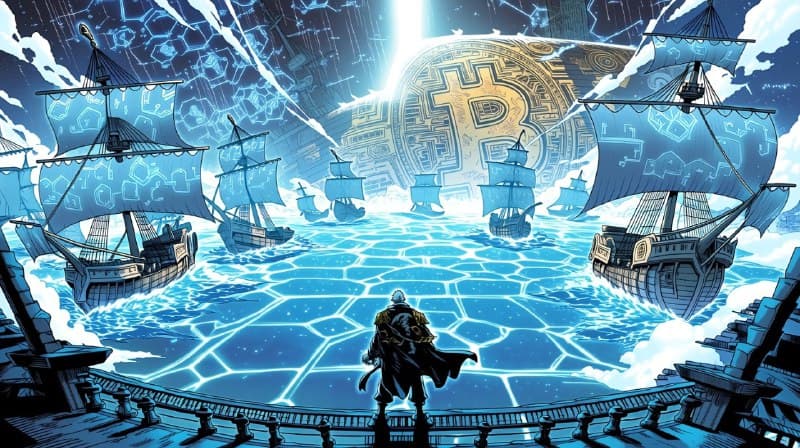
The moment quantum computers become fully capable, roughly 6.9 million BTC whose public keys are exposed on the blockchain will become treasure for whoever gets there first. Hundreds of billions of dollars at current prices. That includes Satoshi Nakamoto’s 1.09 million BTC. Just as pirates around the world headed for the Grand Line when the Pirate King Gold Roger shouted from the execution platform, "I left all my treasure there!", the arrival of quantum computers amounts to a declaration: "There are 6.9 million BTC on the blockchain. Whoever can unlock them can have them." If quantum computers are Devil Fruits, those 6.9 million BTC are the One Piece. A Great Pirate Era begins, with hacker groups like Blackbeard racing toward the treasure.
Any address that has ever sent Bitcoin has its public key recorded on the blockchain forever. With current technology, it is impossible to work backward from that public key to the private key. Shor’s algorithm on a quantum computer breaks this assumption. It extracts a private key from a public key, like copying a key with a 3D printer using only a photograph of the lock. Today’s quantum computers are at roughly 100 qubits, while an actual attack would require millions. The gap is still more than 10,000-fold. But the US NSA has already announced CNSA 2.0 and ordered all national security systems to become quantum-safe by 2030. A network with hundreds of billions of dollars at stake cannot ignore a threat that national security agencies are preparing for.

As the threat takes shape, various insurance products and decentralized derivatives will emerge. Imagine insurance against quantum hacking. Premiums are three times higher for wallets with exposed public keys, and a futures market opens for bets on "the first day Satoshi’s wallet moves." Derivatives will be designed around propositions like "a 10x return if Satoshi’s coins move before June 2031." Insurers will introduce tiered policies, offering coverage only to customers who have completed their migration to quantum-safe addresses. We may even see ETFs tied to an index of quantum computing development speed, a Q-Index. A threat soon becomes a market. With decentralized prediction markets such as Polymarket and Kalshi growing at a breathless pace, there is no way a market will not form around a risk this large and interesting.
Meanwhile, the Bitcoin community has laid out a structural defense. On February 12, 2026, BIP 360 was merged into the official Bitcoin Improvement Proposal repository. At its core is a new address scheme called P2MR (Pay-to-Merkle-Root). The existing Taproot scheme exposed public keys during transactions for efficiency. P2MR uses a Merkle tree structure to prove ownership without revealing the public key. It is designed to let quantum-resistant signature algorithms—lattice-based and hash-based cryptography such as ML-DSA and SLH-DSA—be added like modules. But the merge is only approval of the blueprint. Actual deployment on the network could take four years, like SegWit, or six, like Taproot. Moving all Bitcoin to new addresses alone would take at least 76 days.
Now we face a truly interesting problem for the future. Even if BIP 360 is activated, Bitcoin sleeping in existing addresses will not automatically become safe. BIP 360 provides a new vault. It does not move the treasure out of the old one for you. For Satoshi’s 1.09 million BTC to become safe, someone must sign with those private keys and send the coins to P2MR addresses. Unless Satoshi acts personally, those 1.09 million BTC will remain on the blockchain with their public keys exposed. The day quantum computers cross the threshold, Satoshi’s wallet becomes the spoils of the first pirate to arrive. Extreme proposals are already being discussed within the community. Freezing or burning coins that have not moved to new addresses by a deadline. But this discussion clashes with Bitcoin’s very reason for existing: "No one can touch another person’s property." Consensus will not come easily.
There are three possible endings for Satoshi’s 1.09 million BTC. Satoshi is alive and moves them personally, a quantum computer steals them first, or the community makes the unprecedented decision to forcibly freeze them. Whatever happens, the day Satoshi’s coins move will be the day the greatest mystery in Bitcoin’s history is answered. Did the creator protect them, did pirates take them, or will the community forcibly block them? That day will be Bitcoin’s true turning point.
BIP 360 is the first breakwater against the pirates. But a breakwater alone is not enough. What should we do with the coins among those 6.9 million BTC whose owners never show up? Can we preserve the inviolability of property rights while also keeping the network safe? Bitcoin’s future depends not simply on stopping quantum computers, but on thoughtfully designing a way through the clash between these two principles and building consensus within the community. Did Satoshi foresee even this moment?