Do you remember the Produce 101 vote-rigging scandal? Millions of people poured money, time, and emotion into a vote, only to see it undone by someone changing a few numbers in a back room. The truth is, we had always had our doubts. In a country where rumors of rigging surface with every presidential election and vote-counting methods come under scrutiny after every major audition show, who ever fully trusted the voting system? Most people tend to trust it. Just not completely. What brings a system down is not a great betrayal, but that last 1% gap.
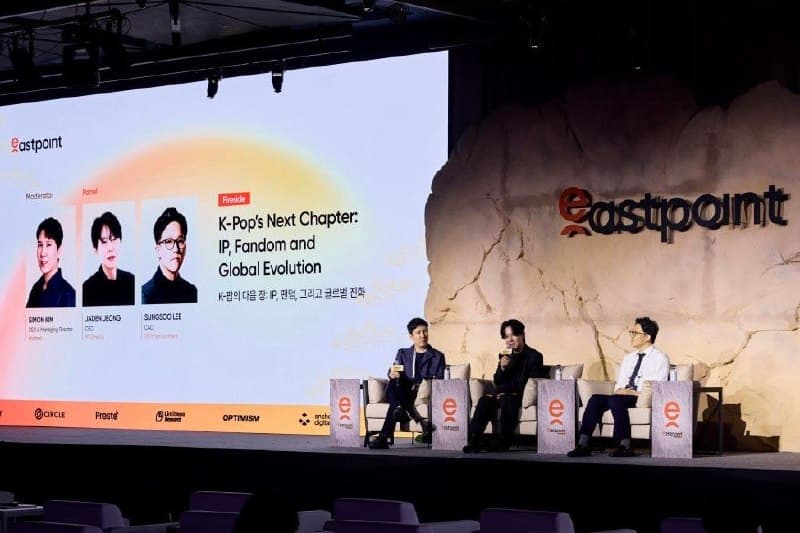
Last month, I joined a panel with MODHAUS Vice President Kwang-hyun Baek and HeeJin of ARTMS at the World Crypto Forum hosted by Maeil Business Newspaper. MODHAUS is a K-pop entertainment startup that Hashed venture-built from an idea Jaden Jeong and I had four years ago. It is experimenting with bringing fans into the decision-making process, rather than treating them as consumers. This was the point I emphasized most at the forum: the biggest reason for using blockchain was to bring the existing system’s 99% trust as close to 100% as possible.

MODHAUS does not put blockchain front and center. This was our most important principle from the start. Fans using its platform app, Cosmo, do not need to know which chain it runs on. They log in as they would with any other service, while a wallet built with account abstraction keeps things running smoothly behind the scenes. The technology steps back behind the experience rather than standing in front of it. But being invisible does not mean being inaccessible. Anyone who wants to can look directly at the flow of every asset and token on a blockchain explorer. So when doubts spread through the community, fans with developer backgrounds pull up the data and voluntarily defend that trust. It is the accessible record, not an explanation, that protects the company.
What happens during an important vote is even more interesting. Fans read and analyze public records to see how many tokens remain in each wallet and how much support each community can rally. Fan communities for particular members plan strategies, count their remaining votes, and work together to carefully shape the outcome. At this point, a fandom is no longer a loose collection of enthusiasm. It is a small political community. This is the moment a light stick becomes a parliamentary gavel.
Another key part of this structure is that photocards are issued on a public blockchain. A fan in Seoul can instantly exchange or trade a card with a fan on the other side of the world. Where photocards once were collectibles that piled up in drawers, they are now digital assets that cross borders carrying relationships, memories, and the right to participate.
The numbers bear this out. More than 15 million photocards have been issued across MODHAUS’s three groups, tripleS, ARTMS, and idntt, and trading volume is more than twice that. Even across the entire global NFT ecosystem, this is among the highest levels of activity. It is also striking that some cards from tripleS’s debut season trade for more than 30 times their original price. But what matters is not the market price. It is that the community keeps using, collecting, and exchanging these assets, giving them meaning.
This casts the failures of early NFT projects in a different light. The problem was not the container, but what was inside. A sense of belonging, a sense of participation, a trace of contribution, proof of a relationship. They failed to hold what communities actually wanted. Too many projects sold scarcity alone and never created a reason to use what they offered. MODHAUS’s photocards, by contrast, are voting rights, participation rights, records of memories, and a way to preserve the relationship between fans and artists. When the container has something inside, the ecosystem survives. When it is empty, meaning collapses before the price does.
The structure of the voting token also deserves attention. COMO was not designed as a speculative asset. It can exist only in users’ wallets and in a burn wallet for permanent deletion. It is not something buffeted by outside markets, but fuel used and consumed only within the fandom. A structure where the flame remains, but no ash piles up. This token reveals less about how much money you can make than about where you choose to put your heart.
What HeeJin said mattered, too. She said that when she signed with MODHAUS, the platform itself meant something to her, but what mattered more was the trust she felt in working with Jaden Jeong again. Her words reveal the essence of this structure. Not technology that removes trust in people, but technology that supports that trust so it is not betrayed.
HeeJin pointed to the permanent record of every photocard trade and vote as a major strength. This is not just about fans. Artists, too, can verify that the fans’ choice really is their choice. More interesting still is how this system changes the artists’ own instincts. HeeJin said there had been a time when the members preferred a different song, but decided to trust the fans’ choice rather than push their own. It seems like a small moment, but it is a significant one. In the entertainment industry, fans have been people who consume the outcome, not people who help create it. Here, that relationship is reversed. Fans become part of the choice, and artists accept it on a foundation of verified trust.
We cannot leave out how revenue is paid out. MODHAUS pays artists their share of digital photocard sales right away. HeeJin said she used that money to do something she had wanted to do since she was young: fill her malatang bowl with ingredients without worrying about the price. I like this moment because it brings a grand discussion down into the texture of everyday life. Words like blockchain and transparent payouts easily drift into abstraction. But a system’s real value is proven only when it reaches someone’s life. A structure where fans can feel their participation matter, and where artists receive both income and trust. The moments when technology changes relationships always reveal themselves in small, everyday things like this.
HeeJin also said that public sales figures are both a strength and a burden. Transparency brings fairness, but also comparison. What MODHAUS shows us is not a perfect utopia. It is the possibility that a more transparent system can create more trust, alongside the reality that we must also bear the pressure that transparency places on people. That is precisely why this experiment feels real. The technology does not erase tension. It reveals a more honest tension.
MODHAUS is interesting not because it is an example of blockchain applied to entertainment. It is interesting because it shows that, in fandom, one of the most emotional and human of realms, 99% trust and near-100% verifiability really do create different worlds. With 99% trust, people participate but still have doubts. With near-100% verifiability, people build deeper emotional connections. Participation without doubt becomes stronger engagement, and stronger engagement becomes a more solid community.
In the end, what blockchain does is not a grand revolution. It closes the last gap in trust that already existed. That tiny difference goes beyond changing systems. It changes relationships.
Entertainment is an industry built on the emotions between people. A world where there is no need to doubt a vote. A world where participation is real participation. A world where fans’ choices do not have to depend on someone’s goodwill. In such a world, just how far could the relationship between fans and artists go?