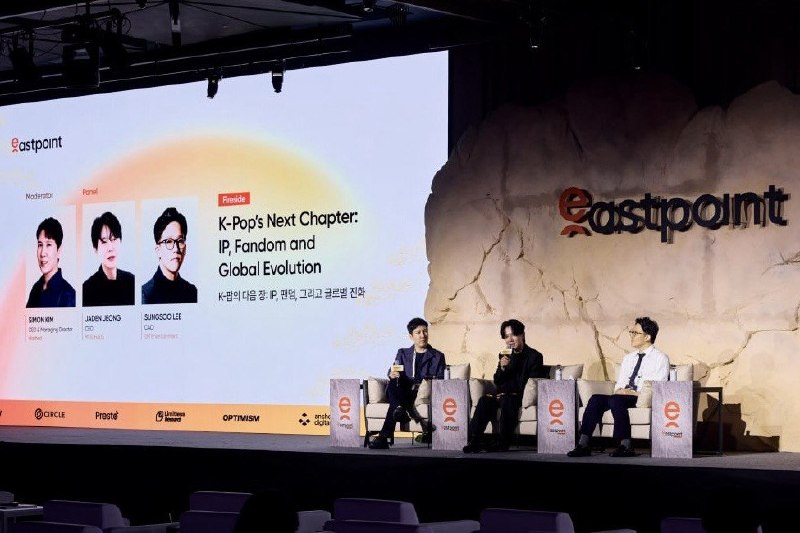
September 28, 2026, Seoul, EastPoint 2026
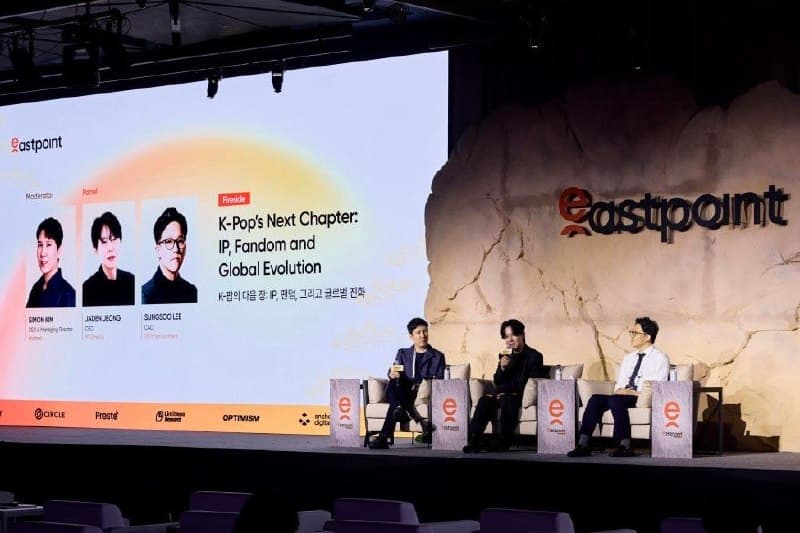
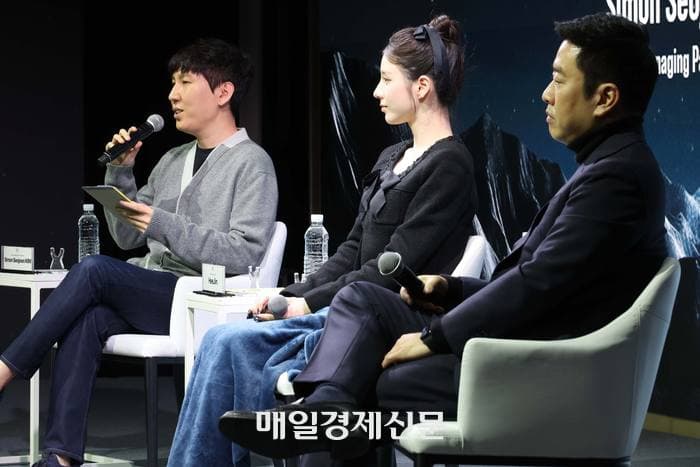
 Simon KimIt feels special to be sitting here with both of you. The reason I started MODHAUS with Byung-ki Chung, here in the middle, was a meal with Sung-su Lee. We talked about how it would be fun to create an idol group where fans could participate through blockchain governance, and Sung-su introduced me to Byung-ki. That was how tripleS, ARTMS, and idntt began. Could you each briefly introduce yourselves?
 Byung-ki ChungHello. I'm Byung-ki Chung, CEO of MODHAUS.
 Sung-su LeeHello. I'm Sung-su Lee, head of A&R at SM Entertainment.
Simon KimLet me start with Byung-ki. K-pop began as a music industry, but now a lot of revenue is coming from other areas, including live performances. Should we still see K-pop as music, or as an IP or fandom industry? And if so, who are our competitors?
Byung-ki ChungI've been calling K-pop a character industry for ten years. There's no denying that music is its foundation. But I think the reason K-pop has gathered such a large global fandom is that it went beyond music and approached things through characters. Sung-su and I have been friends, colleagues, and rivals for over twenty years. Did EXO, the group he created, build its fandom on music alone? Not at all. EXO had a superpower concept. That was a device for building characters, not music. When LOONA, a group I created ten years ago, became a global phenomenon, I think its strength lay in its characters too. So I don't see other K-pop companies as our competitors at all. Our competitors are works like 〈KPop Demon Hunters〉 and 〈Jujutsu Kaisen〉.
Simon KimWhat do you think, Sung-su? K-pop used to mean Korean people singing Korean songs. Now there are K-pop groups without a single Korean member. What is K-pop becoming?
Sung-su LeeK-pop mixes so many musical genres that you can't explain it as a single genre of music. I see it as a content genre. It brings together music, performance, music videos, and the most powerful fandom. It belongs alongside musicals and opera, not Latin music or EDM. It's true that K-pop's production system created K-pop. But a system should be reproducible with a manual, and culture doesn't replicate that way.
Simon KimByung-ki, this question gets at the identity of MODHAUS. Fans used to simply receive what companies made, but MODHAUS has opened even governance to them. How is the relationship with fans changing?
Byung-ki ChungUntil now, what mattered was how much money you could get fans to spend. What the big platforms want now is time and attention more than money. Getting fans to spend more isn't our goal either. What matters most is how deeply fans engage and how much loyalty they develop. That was what I had in mind when I met Simon and we started MODHAUS. Let's build a company where fans can participate as deeply as possible. It's hard for a company like SM, built within the existing conventions, to take that path, so let's start there from the beginning. That's why fans vote to decide the groups' activities and direction.
Simon KimHow has it worked out?
Byung-ki ChungMore participation wasn't always better. Some fans said they were tired from being so involved. Drawing on four or five years of experience, we're still looking for ways to reduce fatigue and increase participation.
Simon KimSung-su, SM operates with a multi-label structure. Will this approach become essential?
Sung-su LeeGlobal music companies like Universal, Sony, and Warner grew by creating or acquiring labels, and distribution was always at the center. They had to export CDs and manufacture them under license. But IT, AI, and blockchain have broken down that structure. Now we can deliver everything online without shipping CDs, and market it in completely different ways. So the reason we're pursuing multiple labels now is balance rather than expansion. If we keep making only the music we make now, we'll gradually get stuck in one genre. To grow as an industry, we need to understand different genres and learn the different approaches each one requires.
Simon KimPeople say it's getting harder for new agencies to compete with the big companies. What opportunities do they have?
Sung-su LeeCompared with SM, MODHAUS is a new company too. But now is actually a time of opportunity, because the landscape is changing. A company like SM has to work within the inertia and systems it has built up, but a new company can design everything from scratch. SM can't build something like MODHAUS's COSMO right now. Instead, we'll move gradually by collaborating with companies like that and providing a foundation for them. Going forward, I see greater opportunities for companies designed quickly for this era than for large companies.
Simon KimWe've heard a lot about AI at EastPoint today. Byung-ki, how much will AI change K-pop? How much of what artists have brought as human beings will remain?
Byung-ki ChungI imagine everyone here uses AI and looks forward to its future. But K-pop is probably the most conservative market when it comes to AI. Across the fandom, there's an allergic reaction to AI entering artists' work and harming its essence. I don't want to argue against that reaction. That's the reality today, and I think we can wait to use AI until fans are comfortable with it.
Simon KimOne last question for Sung-su. I've been hearing about a crisis in K-pop for ten years, but K-pop has kept growing throughout that time. What is the real crisis, and where are the new opportunities?
Sung-su LeeWhen I first started working, the term K-pop didn't even exist. It emerged around 2011 or 2012, when Gangnam Style became a global hit and people were asking, "That came from Korea?" For fourteen or fifteen years since then, I've been asked when the crisis would come, but K-pop has kept finding opportunities rather than crises. That's because good music keeps coming out. We keep creating stages that make business possible, so smart people gather here, and songwriters send their good songs our way too.
Simon KimSo when will the real crisis come?
Sung-su LeeWhen K-pop loses its edge. Localization is good, but if we lose our sound and context along the way and become indistinguishable from pop, we'll eventually be swallowed up. In the end, what matters most is the essence of music and the fandom that consumes it. MODHAUS is doing a lot of experiments on that front. What happens when you give fans governance? How much can fans get involved in things that producers and companies used to lead? Can the industry keep developing within that structure? I think good answers will come out of this.
Simon KimThank you for your thoughts.