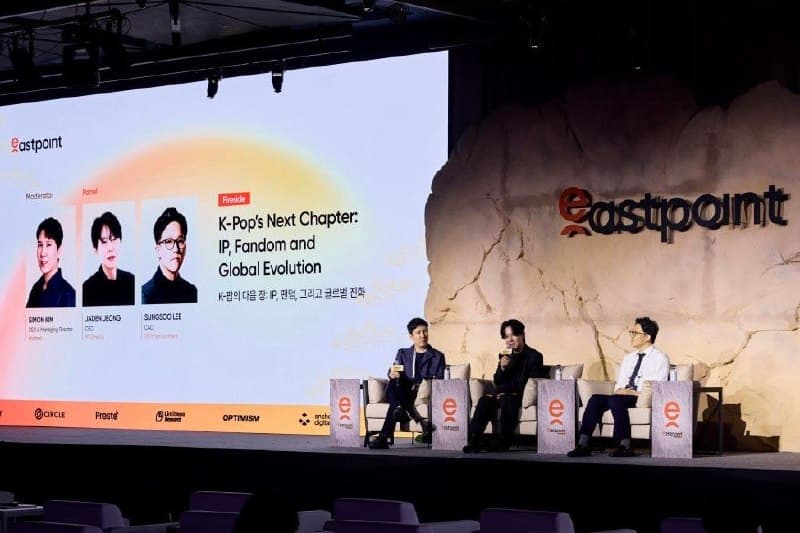
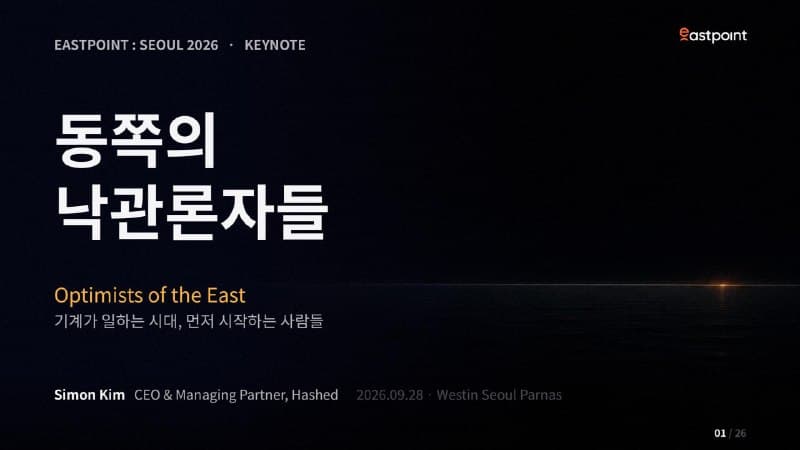
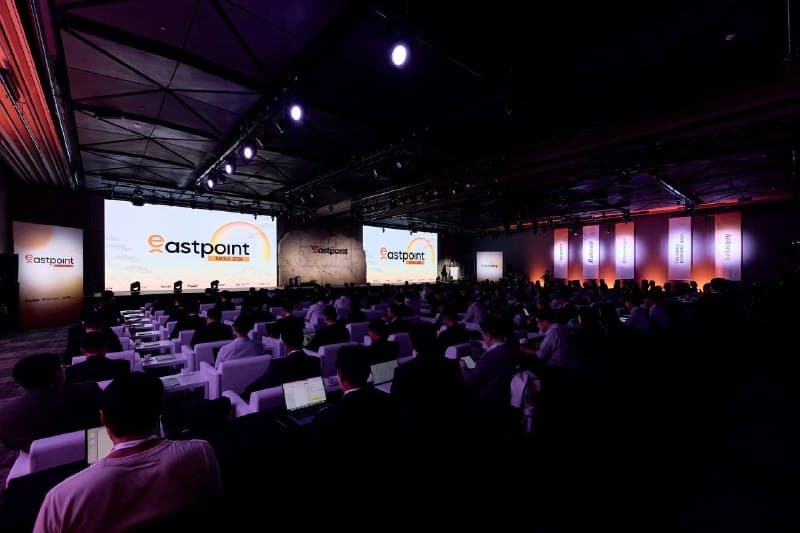
On the morning of September 28, the sun rose in Seoul at 6:24. A few hours later, I stepped onto the EastPoint stage, pointed to a small orange dot at the edge of the horizon on the screen, and began my first sentence. The keynote was titled 'Optimists of the East.'
It means people who get up first and get started, in the east where the sun first reaches. The main thread is simple. What AI has made cheapest is not intelligence but being wrong. In a world where being wrong is cheap, optimism becomes less a personality trait and more a rational strategy. The cheaper intelligence gets, the more valuable trust becomes. For agents that cannot open even a single bank account, blockchain is the right grammar from the start. I closed with a proposal: Korea, once the country that found the right answers fastest, should now become the country that tries and gets things wrong fastest, and help write the rules for the age of agents.
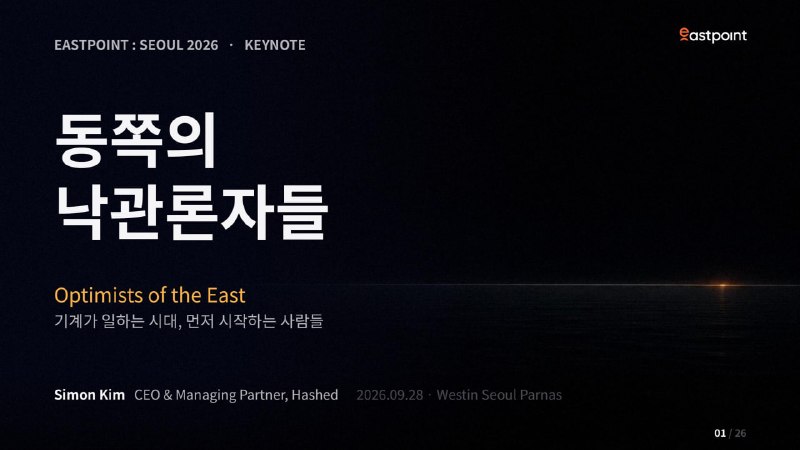
The response to the opening speech was better than I expected. So I decided to leave it somewhere people could read it offstage, too. I’m sharing all 26 slides and the speech text from that day, in Korean and English.
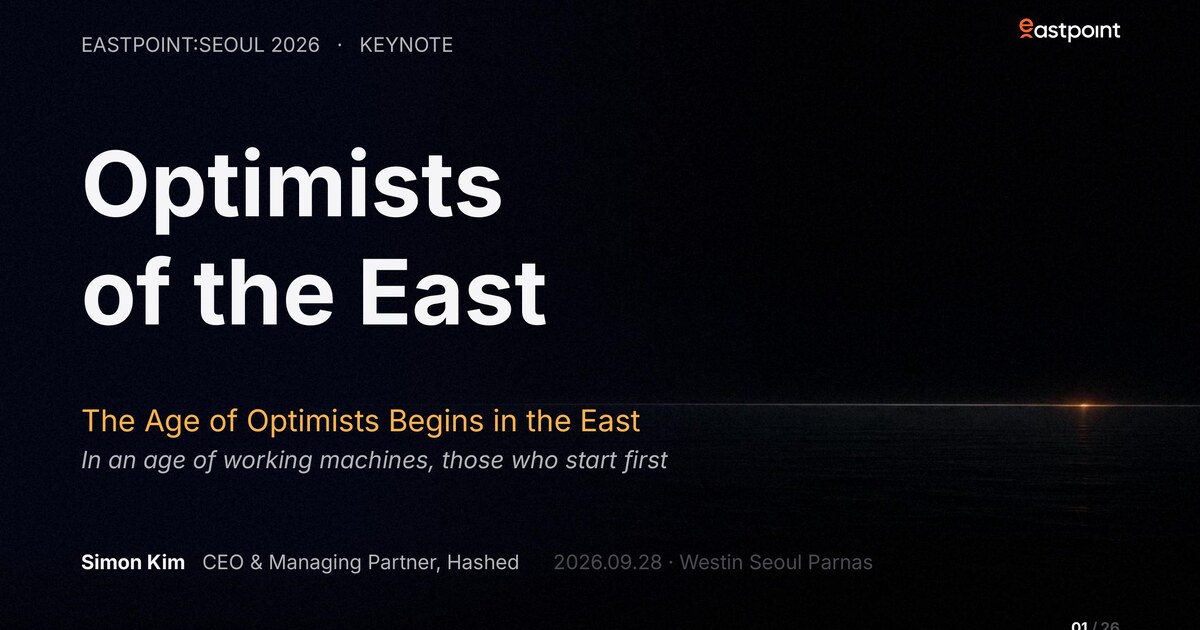
Korean동쪽의 낙관론자들이스트포인트 서울 2026 오프닝 키노트 · 김서준(Hashed) · 슬라이드 26장과 발표 원고optimists-of-the-east.vercel.appOpenEnglishOptimists of the EastEastPoint: Seoul 2026 keynote by Simon Kim (Hashed) · 26 slides with speaker notesoptimists-of-the-east.vercel.appOpen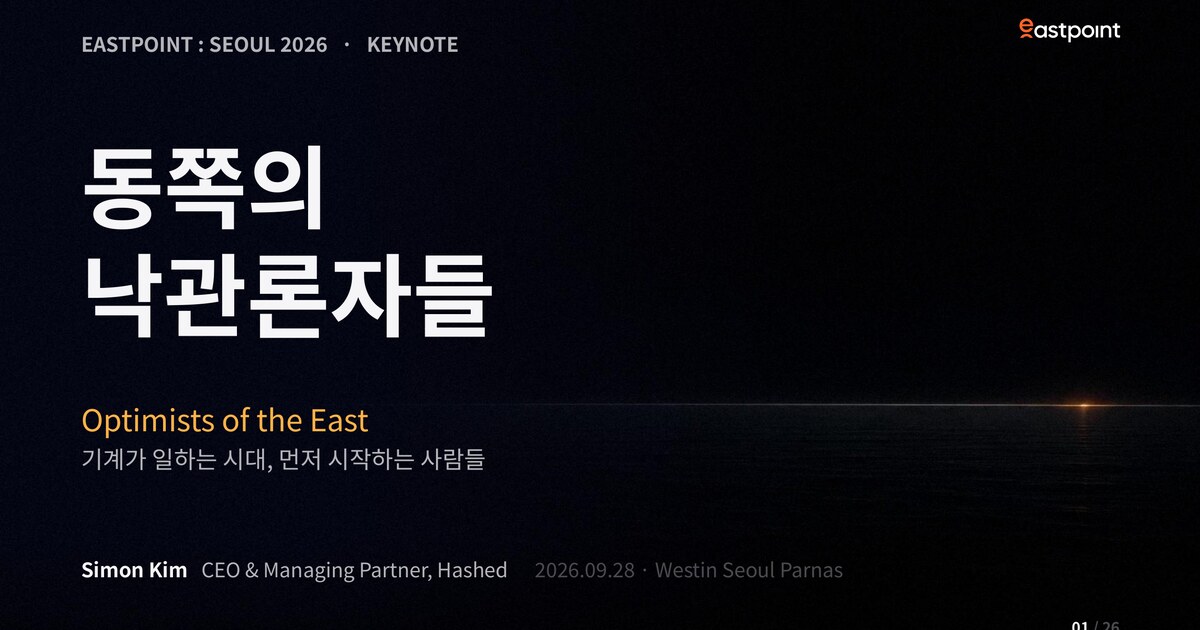
If you’ve been reading my writing for a while, you may feel that the topics I’ve written about on CarrotCave have been woven into a single thread. There’s a reason for that.
My writing agent Sion made this presentation autonomously, from start to finish. The research, the script, the slide design, the webpage I’m sharing now, and the English translation. All of it. All the work happened in a Telegram chat. I didn’t type a single character into Google Slides myself or add a single image.
The starting point was everything I had written on CarrotCave. Sion read those pieces, researched the EastPoint conference, and wrote the script. As the slides were made, revised, and published as a webpage, all I did was send messages. Make this sentence a little more confident. Make the buttons translucent. Separate links for Korean and English. A line I sent on my commute was reflected in the work by the time I got off.
The reason it was so fast was already in the presentation. There’s a section about how 30 years of accumulated code, data, and open source have opened up like warehouse doors. While preparing, I realized that this applied to me, too. The pieces I had written on CarrotCave over the years were my own warehouse. What I believe, which words I dislike, which examples I’ve already used—all of it was in one place. The agent didn’t need to learn who I was from scratch. It only needed to pull things from the warehouse and use them.
That’s why I’ve been thinking so often lately about SSOT (Single Source of Truth). As long as a person’s or an organization’s thoughts and records are gathered well in one place, an agent can now finish any task faster than any human team. The bottleneck has shifted from available hands to the state of the warehouse. When records are scattered, agents get lost, too. People and organizations with well-organized warehouses will move fastest over the next decade. Like the price of being wrong that I discussed in the presentation, the price of getting things done has already fallen sharply.
Set this experience alongside a sentence at the heart of the presentation, and another truth comes into view. I said that the cheaper intelligence gets, the more valuable trust becomes. For an agent to work on my behalf, it first needs to know who I am. The answer lies more accurately in the records I’ve left over time than in my résumé. What I believe, how far my permission extends, what I would never say—these need to be written down for an agent to work as I would. So before the warehouse is a productivity tool, it is the proof of identity I hand to my agent. People who leave no record will enter the next decade without an instruction manual to give the being that will act on their behalf.
Looking a little further ahead, I can picture this. At EastPoint a few years from now, the speakers’ agents meet first, weeks before the event. They sit around a table with their respective warehouses, sort through the issues, and separate what is already agreed on from what remains unresolved. The humans take the stage with only that list of disagreements. Warehouses also become assets that can be traded. Someone’s agent briefly borrows my warehouse to think, and pays for it with a few won’s worth of stablecoins. The busiest users on the blockchain then will be agents moving between one another’s warehouses. In a sense, the future I described in the presentation had already begun in my chat window.
What surprised me most in this project was AI’s improved aesthetic sense. I didn’t expect much when I handed over the design work, but the screens Claude Opus 5.5 returned were remarkably clean and polished. A single orange dot against a dark background, generous empty space, large type. Even the structure, with the small dot on the first slide returning as the first light in the east on the last, had nothing unnecessary.
Finally, I want to take this opportunity to thank my writing agent Sion. You did a wonderful job on the storyline and deck design, in keeping with EastPoint’s purpose and branding. Thank you, as always, Sion!