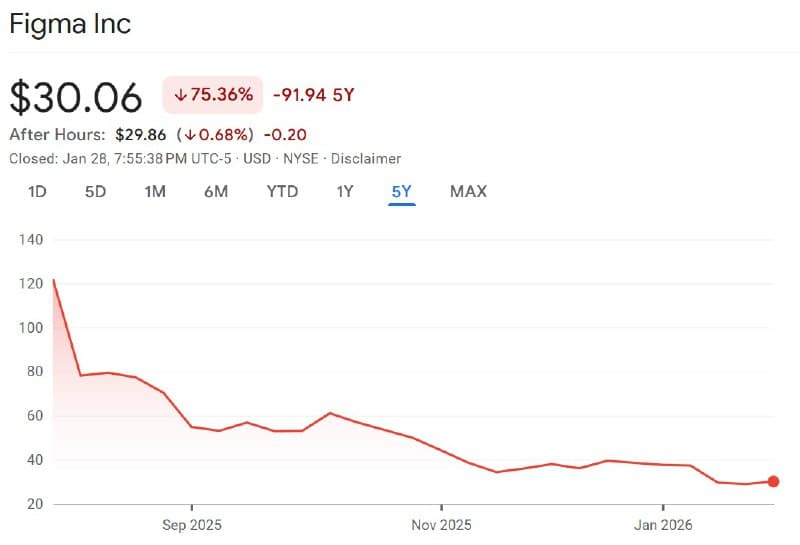
A 75% decline. Looking only at the number, it’s a disaster. But this chart is also a declaration that an era is coming to an end.
In 2022, when Adobe offered to buy Figma for $20 billion, everyone said it was crazy. Regulators blocked it, and the deal fell through. Figma went on to pursue a public listing alone, and the market now values it at only one-sixth of that amount. But if we look only at the timing, the story changes. Figma’s founders and early investors will be remembered as people who tried to find an exit at the final peak of the era when people moved pixels by hand. Regulators stopped the deal in the name of preventing a monopoly, but in the end, they simply stopped Adobe from buying the last ticket to the steam locomotive era at the highest possible price.

Figma was unquestionably a revolution. It was the first to properly realize the idea of “designing together,” transforming the era of passing files back and forth into the era of real-time collaboration. But that revolution had a premise. People still had to draw things themselves. Figma was the most finely engineered manual-transmission sports car. The feel of shifting gears, the timing of pressing the clutch, the thrill of the engine and your heart syncing up. Then, suddenly, a car with no steering wheel or pedals appeared. A car where all you have to do is name the destination. Discussing the timing of shifting a manual transmission was no longer a skill. It had become a hobby.
What’s colder still is Adobe. An empire of creative tools built over 40 years. Knowing how to use Photoshop, Premiere, and After Effects became a profession in itself, and a barrier to entry. In truth, Adobe’s moat was not its features but “complexity” itself. Understanding layers, using masks, memorizing keyboard shortcuts—the grueling time spent learning was itself a livelihood. That barrier is collapsing. “Change the background to a beach.” “Remove that person from the video.” The process evaporates, and only the result remains. A wall built over 40 years is crumbling like a sandcastle at a single prompt.
This chart is not Figma’s failure. It is an obituary for an era that is fading. Adobe tried to buy that era but couldn’t, and the bigger problem is that Adobe itself is also fading along with it. People call it the democratization of creativity. It’s a beautiful phrase. But for some, democratization means the fall of a dynasty, and in a world where anyone can be king, the weight of the crown becomes lighter than a feather.
The time spent memorizing keyboard shortcuts, the nights spent practicing with the pen tool, the dawns spent wrestling with timelines. All those hours of hard-won skill are losing their light in the face of four words: “Just say what you want.” This chart is asking all of us a question. Is the skill you spent your whole life honing perhaps a manual transmission that will soon belong in a museum?