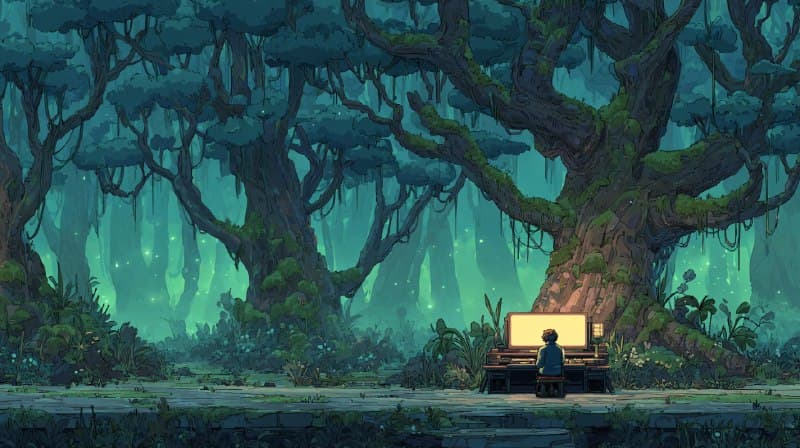
Beyond vibe coding, we are approaching a stage where products are born not simply “as we think,” but at the very “speed of thought.” Even now, we spend a long time waiting for an agent to compute after sending it a prompt, and digging through logs and debugging by copy and paste are still part of the process—but honestly, this is nothing more than noise that will evaporate within a month, or three months at most. Once MCP gets a little sharper and computing approaches the speed of light, the bottleneck will suddenly move into our brains. A strange future in which the fingers doing the typing, the words lingering on the tip of our tongues, and even an ambiguous mumble like “Hmm… maybe make it sexier?” become shackles on the speed of development.
Human thought is slow, blurry, and clumsy by nature. How many hundreds of millions of combinations of pixels, colors, proportions, and emotions are contained in the single word “pretty”? We have been speaking without knowing exactly what we meant. But what happens when execution becomes immediate? That ambiguity is exposed in its entirety. When the gaps in the net of language become starkly visible, we realize for the first time just how low-resolution our own thinking is.
So perhaps the next evolution will be resolution, not the speed of thought.
Or, more realistically, it will be a dramatic improvement in AI’s ability to upscale our blurry intentions into ultra-high resolution. We will continue to speak by “throwing something out there,” and the machine will draw an elegant form from it. Humans will grow lazier, and machines will increasingly become prophets.
At this point, the very concept of an app melts away.
At the words “Show me the current state of my portfolio,” a dashboard that exists only in front of my eyes at that moment appears as if evaporating into view. After I look at it, it disappears like air. If I need it, I save it then; otherwise, it evaporates like a forgotten dream. Software passes from solid to liquid to gas, and eventually becomes ionized, like plasma. It is spread everywhere, and when you try to hold it, it slips through your fingers.
Then all the metrics we are obsessed with now are illusions.
App Store rankings? Number of downloads? MAU? How do you measure the ranking of something that does not even exist? Reviews become a comedy too. The version I saw for 0.3 seconds and the version you saw for 0.7 seconds are completely different, so what exactly are we evaluating?
The most ironic twist is that the moment everything becomes possible, the things we want to make will dramatically decrease.
In 2015, there was that time I spent all night reading, imagining, and trembling without understanding the Ethereum white paper. Now, if I say “Analyze this,” a 40-page report pours out in two seconds. But standing before that report and nodding as I say, “Hmm… not bad,” what weight does my judgment still carry? When scarcity disappears and everything is leveled out, what becomes truly precious is slowness.
An object that takes three weeks to make on purpose.
The act of intentionally leaving a bug and fixing it all night.
The time in which a thought does not become reality immediately, but slowly matures over several months.
That slow pain and waiting may become the most luxurious experience in the age of thought-speed. A world where an app for intentionally not thinking becomes a bestseller, rather than a meditation app. A world where declaring “I’m not going to make anything today” becomes the most powerful act of creation.
And then, a dark thought.
What if reality comes into being the moment you think of it?
A world where, in the instant of anger, in 0.1 seconds of jealousy, a thoughtless “I wish that would disappear from in front of my eyes” is executed literally.
That safe gap that existed between thought and execution may, in fact, have been humanity’s most important firewall—the one that allowed us to survive for 200,000 years.
In the end, technology does not make us faster.
The moment everything becomes possible, we must learn, for the first time, how to slow down in earnest.
How to distinguish between things worth thinking about and idle thoughts that are fine to let pass by.
How to distinguish between things worth making and things that are more beautiful kept forever in the imagination.
In a world where every possibility is placed in our hands, true freedom becomes the power not to choose.
An age in which the world is born at the speed of thought.
At the end of it, what we may have to learn could be the oldest skill of all.
How to stop.
How to be silent.
How to love something without making it yet.