Khao Yai Art Forest in Thailand was a mysterious place. Works of art were scattered throughout the forest, and beside them sat founders, investors, and researchers from across Asia, gathered to talk about the industries of the future. FOREST FORUM 2026, held in this space being developed by CP Group, did not feel like an ordinary conference.
The moderator had prepared questions, and I had prepared answers. But once we began, the conversation took a much looser, more spontaneous turn. Was it the air out in nature? Instead of giving presentations, people began voicing questions they usually kept to themselves, in language a little less polished. I too found myself talking more about ideas I had carried for a long time than giving the answers I had prepared.


I brought up how much AI might change understanding between beings. We are used to talking about AI as a technology for productivity. A technology for writing faster, building faster, analyzing faster. But one of the fundamental changes I am watching is how it lowers the cost of understanding between one being and another. Even at a workshop like this, people spend only about ten minutes talking with each other, twenty at most. In that short time, we see only the tip of the other person's iceberg. Even when we sense that someone is interesting, we barely reach the structure of their thoughts, the layers of their memories, or the texture of their judgment.
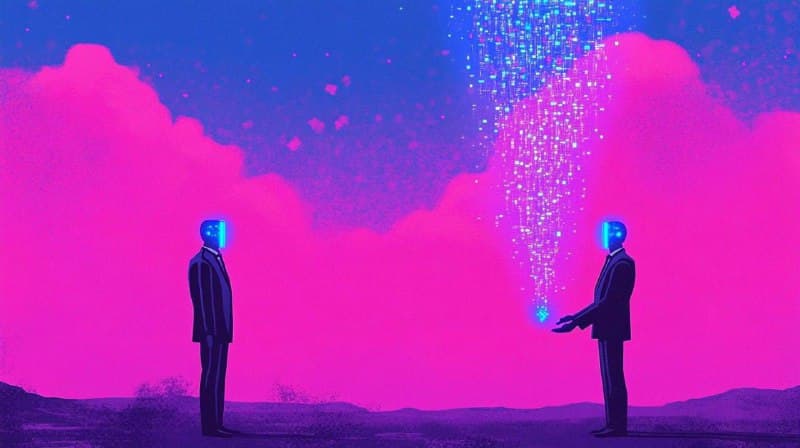
I shared a possibility I had been imagining. A future in which we have deeper conversations alongside personal AI agents that understand us best. If someone's agent has spent years reading and accumulating their notes, conversations, tastes, concerns, turns of phrase, and recurring questions, we will meet not simply as one person encountering another, but with a framework for understanding each other already in place. If networking until now has amounted to exchanging business cards, might those future encounters be more like our mental models shaking hands first? Humans will still show only the tip of the iceberg, but agents may be able to translate the shape of what lies beneath the surface a little more accurately. AI's impact will go beyond replacing humans and into helping us understand each other more deeply.
The conversation extended to beings beyond humans. Lately, I have sometimes been recording my dog's barking and analyzing it with frontier models. Is that sound just noise, or is it anxiety, anticipation, irritation? For now, this is more of an experiment. But as these attempts accumulate, we may soon be able to interpret animals' signals with much greater precision.
Could we go a step further and talk with plants? Trees and grasses exchange signals, sensing their environment and one another. We simply cannot read their language. If AI becomes that translator, we may one day talk with a forest. Standing in the middle of the forest as I said this, I felt something subtly different in the air.
The discussion turned to longevity. Someone asked whether radically longer lives would become a privilege reserved for the top one percent. I argued that the opposite would happen.
I brought up the story that had lit up Twitter a few days earlier: GitLab founder Sid Sijbrandij using GPT to cure a cancer that even doctors had given up on. As his options for standard treatment and clinical trials for osteosarcoma narrowed, he gathered as much diagnostic data as he could and examined multiple treatment paths in parallel. He treated his own case like a precision medicine experiment and reached a state close to a complete cure. Using data and models, a patient had begun engaging more deeply with judgments that had once come only from within hospitals.
This does not immediately mean the democratization of medicine. But it seemed at least to signal the beginning of an era in which patients can use AI to become the most active researchers of their own diseases. Today's LLMs are vastly more capable than those Sid used to treat his cancer last year. It is hard even to imagine how much more they will improve.
The spread of mechanisms for reversing aging could follow a similar path. People imagine longevity as a luxury for the ultrawealthy, but the history of software and knowledge has more often moved in the opposite direction. At first, something is expensive and rare. Then, at some point, the cost of reproducing it drops sharply, it spreads more widely, and eventually it becomes a standard that functions as a public good.
Much of the most dynamic activity in the software industry today runs on open source. OpenClaw and the apps in the interesting third-party ecosystem around it, along with many of China's frontier models, are spreading quickly through the practices of open source. Watching this, I see no reason why treatments for longevity, rare diseases, and even aging reversal should not soon take on an open-source character too.
Some will try to monopolize longevity commercially, but others will try to open it up in revolutionary ways. The movement toward a lower cost of reproducing knowledge is already too strong. Just as the price of software code approaches zero won, I shared my view that the secrets of extending life will not remain forever behind walls built for a select few.
And that was where the question I most wanted to ask began. Once everyone lives longer and so much becomes abundant, what will become most valuable next?
I said one answer might be fictional worlds we can love for a long time. The more people live longer, healthier lives, and the faster more creative works are produced, the more what ultimately holds people will be attachments that cannot be copied. Reproducible things will overflow, but symbols that people return to across generations may become more expensive still.
I brought up the Pikachu Illustrator card that recently sold for 24 billion won. Pokémon is not simply a character business. It is a store of feelings carried across generations. A father and son going to see a Pokémon movie together is a familiar sight. It is evidence that a single fictional world is binding the emotions of two generations across time. What gains value amid abundance, then, will not be scarce technology alone, but IP that can sustain rare attachments for a long time. A single card, a single character, a single world becomes more than merchandise: it becomes an asset that binds time and generations together. This is also why Hashed has recently been exploring opportunities to establish a TCG-related fund.
Looking back, everything I shared in the Khao Yai forest was moving toward the same question. AI will create translators between beings. Longevity will give more people more time. Open source will push those benefits beyond the walls of a select few. Once understanding has widened, time has lengthened, and so much has become abundant, what will ultimately remain?
What becomes most valuable then may not be a rare technology, but a being that can be understood and loved for a long time.
If the day comes when the forest truly speaks to us, only then will we understand. At the far end of abundance, what humans ultimately put a high price on is not function but relationship, not information but worlds, not lifespan but the stories we want to stay with to the very end.