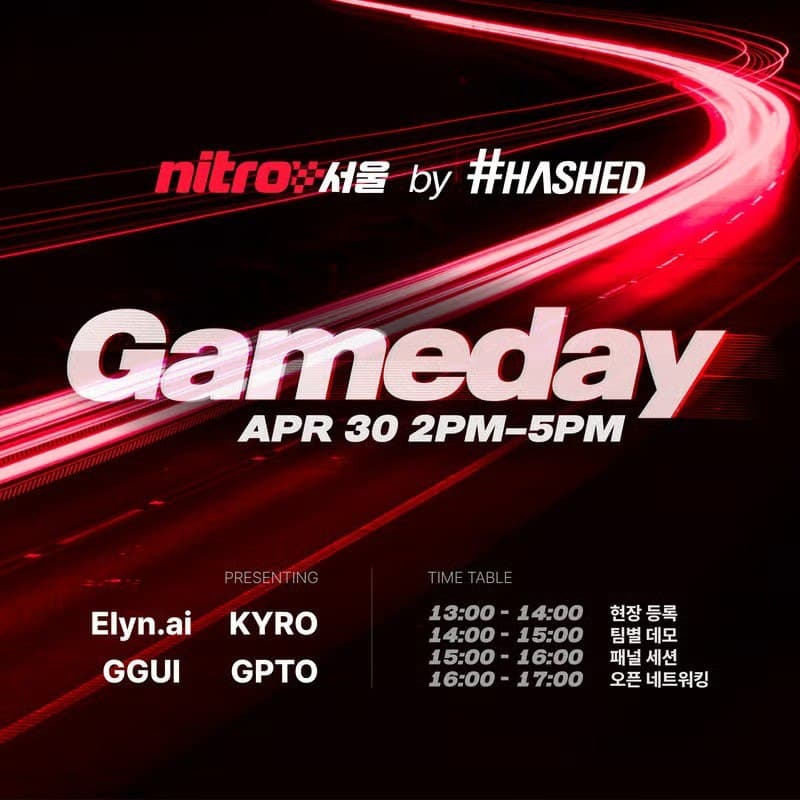
Nitro Seoul wrapped up last week. The demo day stage (we call it Game Day) is empty now, and the applause has faded. That night will keep turning over in everyone's minds for days.
First, the name. We changed Vibe Labs to Nitro. We borrowed the name from F1. That moment when a brief flame appears behind a car coming out of a corner, a burst of acceleration giving an already fast car one more push. That was close to what we wanted to do. But acceleration cannot always be the right answer. Some questions only come into view when you stop. What we wanted to borrow was not speed alone, but the precision of a brief moment that gives something already running well one more push.

Another reason for the change lies in the word itself. I suspect the term vibe coding will disappear soon. In a world where everyone codes in natural language, there is no reason to give the act a separate name.
What does a founder do in a world where coding has become natural language? The sight of ten, a hundred, a thousand agents alongside a single founder will soon be ordinary. What we want to lay down is a track for that uncertain future. Hence Nitro.
I look back on the past eight weeks. The most honest thing to say is that we simply sat alongside them. The problems the Fellows brought each week were not the kind with ready answers. No one held a lantern. We felt our way forward together. Yet somehow, having several people in the same room took the place of a lantern.
The two offsites in Jeju stand out clearly. We stayed under the same roof for days, debating through the night and freely sharing what each of us had learned in impromptu sessions. Some nights, we gathered around someone's laptop and wrote code together. In the city, formalities determine the distance between people. In Jeju, they briefly fell away. Things began to grow in the space they left.
The mix of Fellows mattered too. Engineering, growth, data, design. The room was filled with people who had spent years going deep in their fields. A problem that had occupied a veteran in one field for days often had a one-line answer from a veteran in another field sitting nearby. That was where those eight weeks compressed the most time.
Looking back, the one thing we did reasonably well over those eight weeks was bring together a community people could trust. Put good people in a room, and they will share and grow together on their own. Those eight weeks quietly taught us that the most valuable asset an investment firm can offer is not content, capital, or signaling, but the list of people gathered in the same room.
On demo day, every team's presentation was good. All four teams came into slightly sharper focus that day. It is hard to say whether that extra clarity came from the eight weeks or whether something they had always had simply became visible onstage. Probably both. A few phrases stayed with me as I watched.
Zero refunds. A number worth applauding. But zero may not mean arrival. It may mean you have not reached that point yet. It takes at least one refund for a company to learn something from that one person's dissatisfaction.
Zero won in ad spending is similar. A company that has never turned ads on has never turned them off, either. If it grows without gaining that experience, one day a channel will go cold, and the whole company will go cold with it.
An automated operation run by the founder alone. It sounds like a perfect sentence, but beneath it, judgment debt builds up. Agents replace the people doing the work, not the people making the calls. The quality of one person's judgment becomes the quality of the entire company. It is something to be proud of, and also the heaviest responsibility.
All three were numbers worth being proud of. At the same time, all three pointed to friction they had yet to encounter. Good metrics often tell two stories at once.
It was only a few days after the presentations that the common thread among the four teams became clear. One or two founders were delivering results that would once have taken ten or twenty people. A hundred customers in seven months, 100-fold growth in Japan, monthly revenue in the hundreds of millions of won. Series A traction. Open the org chart, and there are one or two people. Agents occupy the remaining seats.
There is an engineering team. Not colleagues, but agents. Marketing, design, operations, customer support, data: all there. All agents. Only the form of the beings filling those roles has changed.
The celestial model of a company is changing. If companies of the past were several stars of similar mass orbiting a common center, companies of the next era look more like a single person placing their judgment at the center, with dozens of capabilities orbiting it like satellites. Before we even weigh whether this is good or bad, the landscape itself is changing.
The four teams wrote the first page of that landscape with their own numbers.
Nitro does not aspire to be an accelerator. We borrowed that format to begin, but going through the first cohort made one thing clear: what we want to build is not that kind of program. This is a time when founders and investors alike are on shifting ground. Models become different companies every quarter, yesterday's moat disappears tomorrow, and fund cycles struggle to keep up with the curve of change. Every visible frontend is becoming open source. With a little skill and Opus 4.7, you can copy most services in ten minutes. Building something is no longer a moat in itself. How do you compete and grow in this environment? There is no fixed playbook for founders, or, really, for investors either.
Then the most honest thing we can do is not settle on one format and repeat it, but keep replacing the format. Nitro wants to be a series of experiments, not a fixed curriculum. A different length, a different mix, a different recruiting unit, a different outcome each time.
There are three things we want to preserve through all that change. Our place as an investment firm that builds alongside founders. A web of trust that quickly connects stakeholders on the global stage. And a world-class community of agentic builders. We are builders before we are GPs, and the web of trust we have woven from Seoul and Tokyo to Abu Dhabi will remain even as the format changes. The very fact that people working hands-on with the same questions of the same era are gathered in one room may be the most irreplaceable asset we can offer. The first cohort gave us eight weeks that showed the value of that asset more clearly than anything else.
The format may shift, but the essence remains. When I heard that Anthropic rarely makes plans more than a month out, I was surprised at first. Thinking about it again, it made sense. In an environment where models become different companies every quarter, the annual plan may already be an outdated tool. If we learned anything from these eight weeks, that learning should shake up the very format of the second cohort. Running another batch according to the plan we made at the start of the year would be the most honest evidence that we learned nothing from the first. If what you learn does not change what you do, it is not learning. It is inertia.
Once again, I want to put down my thanks to all the founding teams and Fellows who spent these eight weeks with us.