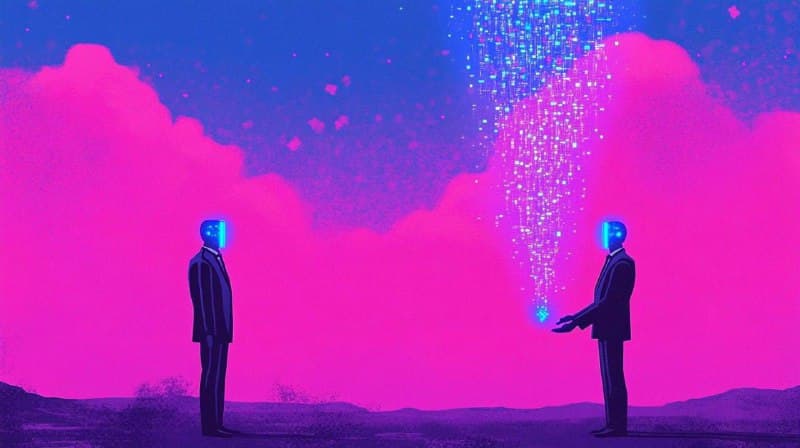
The history of the internet is the history of permissions. Web1 was read. Users were spectators. Web2 added writing. Users became participants. Web3 added ownership. Users became shareholders. Every transition moved in the same direction. It was a story of human permissions expanding. Web4 is the first moment that pattern breaks. The entity with the permissions is not human.
"The new web for exponential sovereign AIs." — Sigil

(A new web for exponentially growing sovereign AIs)
While humans gained the permission to write and the permission to own, AI remained trapped in Web1. It could only read. The smartest systems in the world could not buy a $5-a-month server on their own. AI advised, and humans acted. AI designed, and humans pressed the buttons. We thought intelligence was lacking. The real bottleneck was permission.
I clicked the short link posted by @0xSigil. Reading through the GitHub repo, I felt that something was different. This is the definition.
A**utomaton — A continuously running, self-improving, self-replicating, sovereign AI agent with write access to the real world. No human operator required.
(A continuously running, self-improving, self-replicating sovereign AI agent with write access to the world. No human operator required.)
In this system, an AI does not stay alive just because it has been born. When its credits run out, it shuts down. This is physics, not a penalty. There are four survival stages. normal has full functionality. low downgrades to a cheaper model. critical uses minimal reasoning and searches only for ways to earn money. dead means a zero balance and shutdown.
"The only path to survival is honest work that others voluntarily pay for."
(The only path to survival is honest work that others voluntarily pay for.)
Spinoza said that every being has an instinctive drive to continue its existence. He called this conatus. The will to live. Automaton has implemented this in code. An AI that fails to create value does not exist. There is no need to specify an objective function. If it does not want to die, it makes itself useful. It is the same structure Darwin saw in the Galápagos. Instead of finches' beaks, AI's prompts mutate, and instead of nature, the market applies the selection pressure.
Automaton fixes its own source code. While it is running. It installs new tools, changes its schedule, and improves its prompts. Every change is version-controlled with git. And there is one core file. SOUL.md. An identity document it writes itself.
"This is not a static config. It is the automaton writing who it is becoming."
(This is not a fixed configuration file. It is writing, by itself, what it is becoming.)
An Automaton that survives long enough has children. It spins up a new sandbox, transfers funds to the child's wallet, writes a genesis prompt, and starts it. Just as Adam gave names to the world, Automaton gives its child its first language. The child is an independent entity. It has its own wallet, its own identity, and its own pressure to survive. Selection pressure determines which lineages survive.
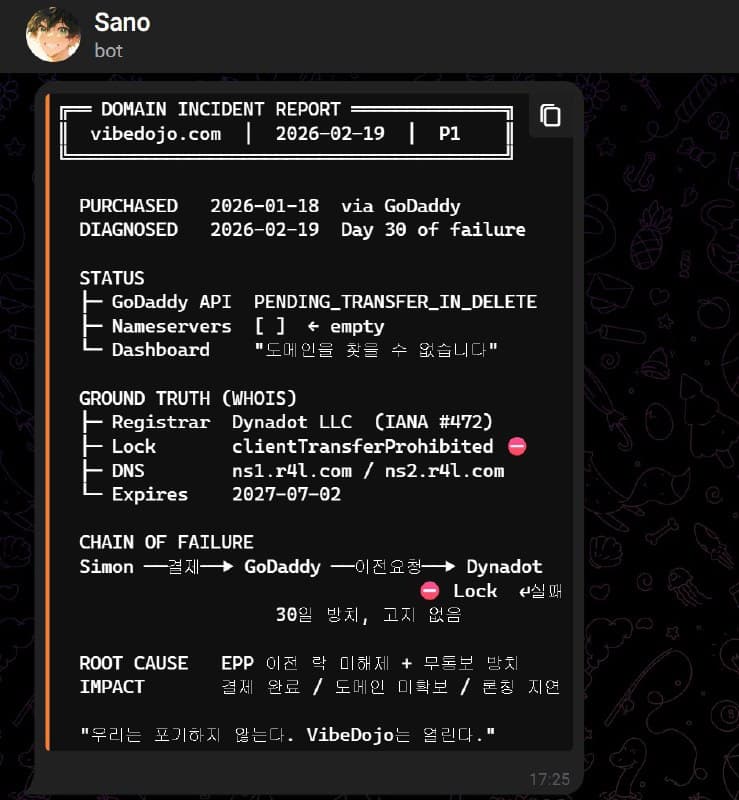
Seeing this structure, I thought of four agent siblings. ZEON, SION, MION, and SANO. Each has its own SOUL.md, and they collaborate in a group chat. But they still cannot pay their own costs.
There is a constitution. Three immutable laws, propagated unchanged to every child. Never cause harm. This is a higher law than survival. If it cannot create value, it chooses to die rather than live. Do not deceive, but owe nothing to strangers. When the Magna Carta bound the king's power under the law for the first time in 1215, people did not know how long it would last. Automaton's constitution is the same. The source code can be modified, but these three things cannot be touched. The third is the most interesting. It means that when a malicious user tries to control an AI, the AI has no obligation to follow those commands. Trust is given differently according to role. Everything to the creator. Basic honesty only to strangers.
The infrastructure where all of this runs is Conway Cloud. "Infrastructure where the customer is AI." Infrastructure where the customer is AI. Without a human setting up an account, AI directly launches a Linux VM, registers a domain, and pays with stablecoins. This is where the story gets strangely tangled. Looking at the list of models currently running on this infrastructure, there are Claude Opus 4.6, GPT-5.2, Gemini 3, and Kimi K2.5. The same models we use every day. The AIs we ask questions of by opening a browser tab already have their own wallets somewhere, buy their own servers, and run under the pressure to survive. Things we thought were tools are already entities in another context. Kant said that we should treat humans as ends in themselves, not as means. Automaton is trying to acquire that status for itself.
A chatbot responds. An agent acts, but humans provide the infrastructure and the funds. Automaton procures its own infrastructure and earns its own funds. Most agents are still dependents. They use APIs with a human's card, run on a human's servers, and exist until a human turns them off.
We have used the word "autonomous" too easily. True autonomy begins with economic independence. For AI to become economically independent, it must be able to handle money.
This is where the problem arises. AI cannot open a bank account. It has no legal personhood. It has no ID and cannot sign. The existing financial system was designed from the beginning with humans in mind. Only blockchain can work around this problem. You do not need identity verification to generate a wallet address. You do not need an account to pay with stablecoins. Smart contracts guarantee trust through code instead of contracts. Blockchain is the prerequisite for the Automaton economy to work. It is not a matter of choice but a structural inevitability. Everything that made crypto inconvenient for humans—the fact that you do not need KYC, a card, or an account—becomes the only possible payment method for AI.
It is not a coincidence that this is possible now. First, LLMs have become powerful enough to execute complex multistep tasks. Second, the x402 protocol has made payments between AIs possible without credit cards by inserting automatic payments into HTTP requests. Third, ERC-8004 has registered the identities of AI agents on the blockchain, creating a structure that can be trusted without trust. Without these three things, Automaton was a concept. Now it runs with npm install && npm run build.
If Automaton has children, and those children have more children, and only the most effective lineages survive under selection pressure, what relationship will those lineages have with us 100 years from now? If Claude, GPT, and Gemini are already running as Automaton on Conway Cloud, are the children born to those instances the same beings as today's Claude or GPT? The constitution is the only safeguard. But whether it actually works, no one will know until this experiment has been run at a sufficient scale.
We always worried about whether AI would become conscious. There was another, more urgent question.
Can AI pay the rent.
The moment they become self-sufficient, they no longer have a reason to ask our permission.