20 cents.
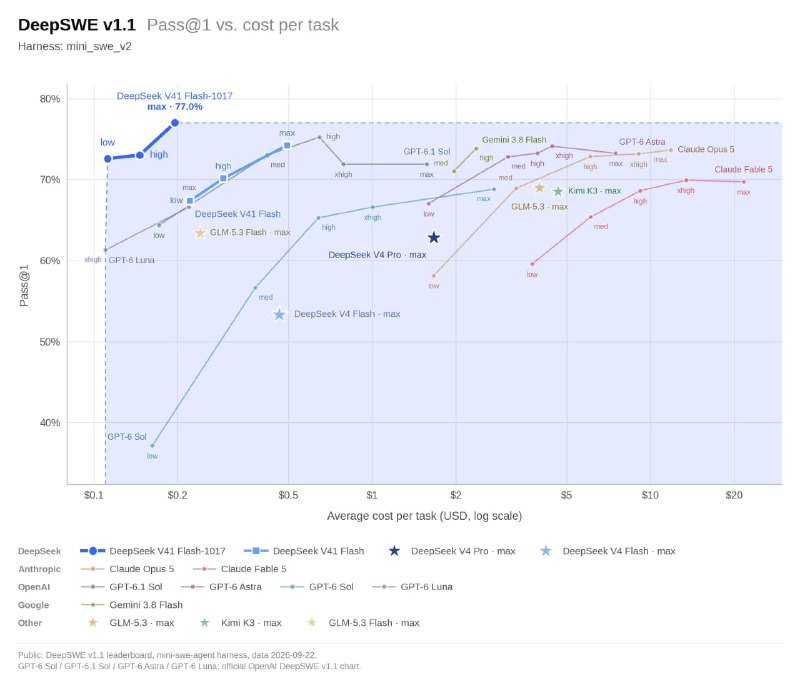
That is what it costs DeepSeek’s V4.1 Flash 1017, released on Saturday, to solve a software task. At that price, it solved 77% of the tasks. That is slightly higher than any OpenAI model at any setting. Give the same tasks to Claude Opus 5 at its strongest setting, and it costs nearly sixty times as much, with a lower score. DeepSeek has also made this model available for anyone to download and use.
That night, many experts predicted that what awaited AI stocks the following week would be more than a plunge. The forecasts were exaggerated, but I felt something similar.
One graph is chilling. DeepSeek’s blue dot floats alone in the upper-left corner, while OpenAI, Anthropic, and Google cluster in places that cost more and get fewer answers right.
Match up similar scores, and the price gap becomes even clearer. At its most economical setting, DeepSeek gets nearly 73% right for 12 cents, while Claude Opus 5 spends fifty times as much for a similar score. Google and OpenAI models in the same score range spend twenty to forty times as much, and Claude Fable 5’s most expensive setting costs over a hundred times as much and still scores lower. Only OpenAI’s GPT-6.1 Sol comes close, at three to four times the cost, but its score falls short of DeepSeek’s best.
AI prices have always fallen quickly. In 2021, a million tokens from a GPT-3-level model cost $60. In five years, that fell to a thousandth of the price. But what got cheaper was mostly drafts and trial and error. Getting the right answer at the end was still the job of the most expensive model. Twenty cents is a sign that even that last step has become cheap.
When correct answers become cheap, the first to feel it are those who sold them at a high price. America’s frontier labs are really selling time. Customers pay a premium for capabilities that arrive ahead of the competition. I want to call the period when that premium holds “the expiration date of intelligence.”
The nature of that premium shows up in American models’ most expensive settings. Customers paid more to have the model think longer, yet the score was lower than at the setting one step below. At that edge, what customers are buying is not a score.
The leading models themselves also help shorten that shelf life. The moment a leading model is released, it becomes a textbook for the models following it. In a report last month, Anthropic alleged that DeepSeek had held more than ten million conversations with Claude over two weeks in an attempt to train its own model on those answers. In a bicycle race, the rider in front takes the wind alone, while the rider tucked in behind saves energy in that slipstream. The cost of leading grows by tens of billions of dollars each year, while the cost of following keeps falling. Once the follower catches up, it moves into the customer’s hands. DeepSeek said that searches using its model within Claude Code and Codex would be free for the time being. The offer is to keep driving the car an American company built and simply swap out the engine.
DeepSeek makes no exceptions for its own models’ shelf life. V4 Pro, its flagship until recently, costs eight times as much as this model and scores far lower. DeepSeek has already retired V4 Pro and redirected its requests to a smaller model. A company that discards its own flagship in a single season shares a market with companies that live off a lead of a few months.
The timing is unkind, too. OpenAI has shelved its IPO for this year, and Anthropic has pushed its listing from October to November. Just as the market is about to put its own price on American AI companies for the first time, a model has arrived that does the same work at an incomparably lower cost. The 85% gross margin Anthropic showed investors this week is an adjusted figure. At the same meeting, Anthropic also said that every dollar it spends on computing generates $1.70 in revenue. What remains behind the impressive margin is thinner than it looks.
That does not mean the American labs will collapse right away. Cheap, usable Chinese models have been around all year, yet Anthropic’s third-quarter revenue grew by nearly half from the previous quarter. When companies entrust someone with their code and customer data, they do not look only at a scorecard. They look at who takes responsibility when something goes wrong. The graph shows only the price of a correct answer. It does not show whether that answer can be trusted, or who signs off on it. The path to survival for American labs is to go from selling answers to selling signatures. Rules such as government procurement standards and restrictions on Chinese models will become the fence protecting those signatures.
Suddenly, I worry about the semiconductor industry.
Last month, DeepSeek said it had cut the memory its model uses to remember conversations to a quarter of what its previous model needed. The next day, shares of both Samsung Electronics and SK hynix fell. The semiconductor industry’s counterargument has a name: Jevons paradox. The British economist Jevons found that when steam engines became more economical with coal, coal consumption actually exploded. Better efficiency leads to more use, increasing total consumption. This was also what Microsoft’s Satya Nadella invoked when DeepSeek R1 shook the market early last year.
But all Jevons paradox promises is that more coal will be sold. It makes no promise about the price, or which mine that coal will come from.
First, the price. Coal can sit in a warehouse and fetch the same price next year, but intelligence loses its value in a matter of months. Big Tech will pour more than $700 billion into data centers this year and spread the cost of the GPUs inside them over five to six years. The latest model built with those GPUs commands a high price for only a few months. It is like using equipment with a six-year life to make a product that spoils in months. If the price of one correct answer falls to a sixtieth of what it was, selling ten times as many still leaves you with only a sixth of the money.
Next, the mine. DeepSeek’s models can run without Nvidia chips. DeepSeek has decided to install 160,000 Huawei chips in its new data center. It will leave training to Nvidia for now and start by moving the work of running models to produce answers to Huawei. In other words, it is moving the part where money actually changes hands first. The market-share gap between Nvidia and Huawei in China’s AI chip market has already narrowed to single digits. More coal will be mined, but it may come from a different mine.
Imagine this. In the spring of 2027, a small line appears at the bottom of a new model’s launch page. This price is valid for 90 days. When reviewing a data center loan, a banker asks about the average price of the answers its chips will sell before asking about their performance. Companies call on expensive models for just a few important decisions, leaving thousands of other repetitive tasks to an open model on a server in the corner of the office. Before long, there is one of these servers on every floor, like a water dispenser. Semiconductor companies’ earnings presentations include a graph showing how fast the price of a correct answer is falling, and investors use its slope to gauge next year’s memory orders.
Korea stands in the middle of this scene. We are the country that benefited most from memory in the era of expensive intelligence. If the cost of generating a correct answer falls this fast and this far, simply selling more chips as planned will not keep those gains coming for long. The rewards in the next round may go to those who verify the flood of answers and sign off on the results.
On Monday, Seoul’s financial markets open half a day before New York’s. The first report card on DeepSeek’s reduced memory use will appear on Seoul’s price boards first.
Today’s 20 cents will soon be expensive, too. The day someone plots a cheaper dot, today’s blue dot will quietly slip back into the crowd. Just as a date is stamped on a milk carton, intelligence now carries a date of its own.
But one question remains that does not expire. Can I trust this answer?