I go to Tokyo every month. Each time, I get the same impression from the back seat of a taxi. Watch the screen for a few minutes, and it feels as though half the ads are for AI.
AI that finds internal documents. AI that picks companies to sell to. AI that recommends job candidates and organizes real estate data. There is far more AI for companies to buy than for consumers to play with. It feels less like getting into a taxi than wandering into a B2B startup demo day by mistake.

This time, instead of letting it pass, I sent a message to my agent, Raon, from the taxi.
“Look up the ads running in Japanese taxis right now.”
Raon soon replied. Based on publicly available campaigns, 62.5% were for enterprise AI services. So the impression I had every month was not entirely an illusion.
Companies with real products and customers were choosing Tokyo taxis for their ads. But what interested me more than the percentage was how consistently the ads said the same thing.
Your organization cannot find information. You are missing customers. You are hiring the wrong people. You are slow to make decisions.
The products differed, but the diagnosis was the same.
Your company still works in ways that are all too human.
Why had these ads gathered inside taxis, rather than in train stations or on billboards in busy districts?
Tokyo has a cheap, dense rail network. Taxis are much more expensive than in Korea. For a trip where you would hail a taxi in Seoul without much thought, in Tokyo you first consider taking the train. The moment a passenger pays that price and takes a seat, they have already passed a filter. These are people moving between meetings on company expenses, business travelers, professionals and executives whose time costs more than the fare.
Before taxi ads track your interests, they ask what your time is worth. The fare itself is the targeting filter.
A person selected this way sits facing a screen an arm’s length away. There is little room for other ads to intrude. Enterprise AI is not something that millions of people each buy once. It only takes one person with a budget to remember the name, look it up at the office, and put it on a meeting agenda. With large contracts for each customer, advertisers are looking not for more eyes, but for eyes that can make expensive decisions.
Tokyo taxis look like a mass medium, but they have grown stronger by leaving the masses out.
The way Japanese companies buy also favors this small screen. A new work tool does not enter a company on one person’s impulse. It must pass through managers and relevant departments, security and budgets, one after another. A startup whose name no one has heard gets stopped before it can even explain its features.
“I keep seeing that company in taxis.”
That does not prove the product works. But it turns an unfamiliar company into one that can be brought up in a meeting. Taxi ads sell a product while installing a budget item that did not yet exist in the company’s mind.
Here comes a strange twist. It is not as though people in Japan use AI more eagerly than people in Korea. In the same international survey, the share of Japanese people who had tried generative AI was less than half that of Koreans.
Then the taxi screen is not a mirror of where the public stands today. It is a trailer showing corporate urgency ahead of time.
Japan’s population is shrinking, people are hard to hire, and old ways of working remain inside companies. For individuals, AI may still be a new technology they have never tried. For companies, it is a candidate to fill the gaps left by people they could not hire, overtime they could not reduce, and know-how that disappeared with departing employees. Because the public does not yet want it enough, suppliers shout all the louder. The market has not yet settled on a name.
Read the screen by product, and you see internal search, sales, hiring, and research. Read it by anxiety, and an entirely different map appears.
There are too many documents. We cannot find customers. We are afraid of missing good people. When the person in charge leaves, the knowledge goes with them.
The advertisers were selling AI, but what the screen displayed were the delays Japanese companies wanted to pay to eliminate.
Then I noticed the meter below the screen. The meter turns time lost on the road into yen. The ad just above it turns time lost inside a company into a subscription fee. Ten minutes looking for meeting notes, half a day choosing sales prospects, three days waiting for an approver. The Tokyo taxi was showing the price of losing time and the price of buying it back in a single view.
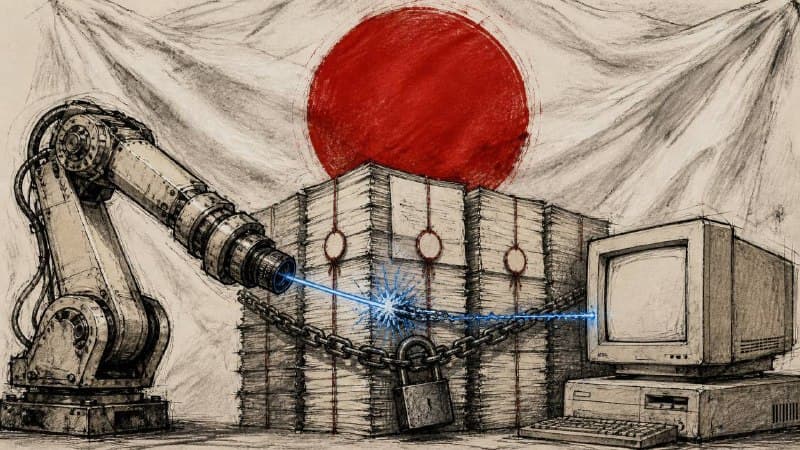
At its core, this is closer to a futures market for labor than an advertising board. Instead of waiting for employees who never arrive, Japanese companies contract with AI in advance for the work of people they will lack. Startups divide future labor into small pieces and sell them as monthly subscriptions, while taxis drive through the city carrying people selected for their likelihood of signing those contracts.
Someday, when a company’s AI agents choose the software they need themselves, this scene may disappear too. Instead of seeking out human executives with ads, AI companies will have to explain pricing, security, and actual results to AI with purchasing authority. The day machines become the audience for advertising, today’s back-seat screens will become relics of an era when the most futuristic products sought out human anxieties in the oldest way.
The next ad began.
“Are humans still doing that work?”
The taxi was nearing its destination. The screen seemed to know more precisely what Japanese companies wanted to escape than where I was going.