Humanity has never controlled its dreams. When we fall asleep, we are pulled into them, and when we wake, we forget 99% of the landscape. Even though we spend a third of each day there, that time belonged to no one else. That time is about to end.
A company called Prophetic began taking reservations this week for two headbands. The basic model costs $449, and the advanced model costs $1,299.

www.prophetic.com
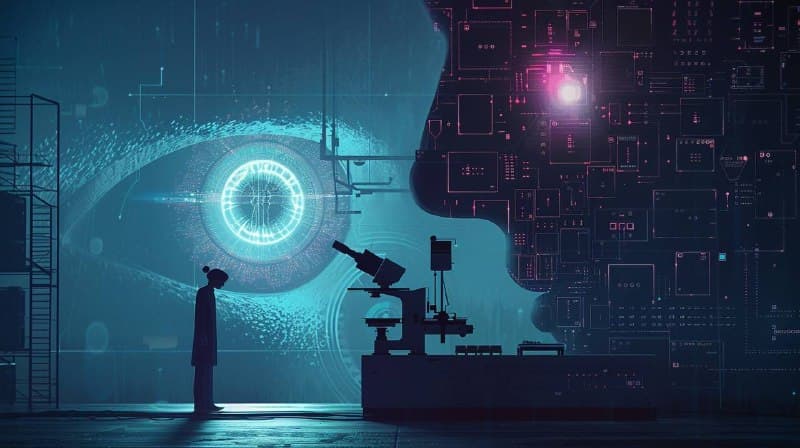
It reads, from outside the head, the brainwaves of a sleeping person—the tiny electrical rhythms the brain sends differently when awake and when dreaming. From those rhythms, it identifies REM sleep, the phase when the eyes move rapidly and the most vivid dreams occur. At that moment, it directs focused ultrasound at the prefrontal cortex, a palm-sized area just inside the forehead that lights up when a person realizes, "I know what I'm doing right now." Ultrasound is a technology that concentrates inaudible sound waves at a single point and sends them through the skull. It's like gently tapping one part of the brain without a scalpel. That tap wakes the self inside the dream.
A lucid dream is a dream that continues while you remain aware, within the dream, that you are dreaming. The hardware was designed by the team that created Neuralink. Its founder, Eric Wollberg, started this work while studying theology in Jerusalem. Abraham, Muhammad, and Buddha all received revelations in dreams. He seems to have decided that couldn't be a coincidence.
The moment I saw the news, all kinds of ideas kept coming. $449. That's less than the price of an ordinary smartphone. What is this price about to unlock for humanity?
Dreams were humanity's last wilderness. Cities were organized, time was divided by clocks, and desire was sorted by algorithms. Even so, no one could enter the mind of a sleeping person. The place Jung called the unconscious meant an uncontrollable realm. Just as the last primeval forests in nature disappear, it is time for the last primeval forest inside us to disappear too. A headband that tames that wilderness is being sold for $449.
Lucid dreaming itself is not new. It was systematized academically in the 1980s, and practitioners reach it through years of training. Training was the bottleneck. The headband flattens that curve. One year becomes the first night. This is the moment practice turns into a subscription. This is exactly where the danger lies. Only those who reach it see the landscape through practice. With a subscription, everyone sees it. The value of the landscape was proportional to the cost of reaching it. When the cost disappears, the landscape is leveled along with it. Enlightenment becomes a $449 accessory.
The first thing that comes to mind is treatment. Clinical work already exists in which people with post-traumatic stress face traumatic scenes again inside lucid dreams and change the ending. For people whose minds are hurting, the prescription becomes not a chemical but a dream rewritten. A headband beside the medicine bottle is not far away.
So far, this is predictable. What comes next is more interesting.
The moment lucid dreaming becomes mainstream, the day becomes 32 hours long. The eight hours spent asleep become conscious time. Soon, some people will write code, write screenplays, and simulate meetings in their dreams. The moment it becomes known that those people are faster, sleep is no longer rest. It is as if a new time zone has been discovered for the first time since the Industrial Revolution. This time, though, the new continent is inside my head. And as with every new continent, those who arrive first take the most.
The sleep divide begins. Until now, inequality emerged during waking hours. Who goes to a better school, who works more, and who gets up earlier. The headband drags the horizon of inequality down into sleep. The rich buy headbands designed to let them rest in their dreams, while the poor receive a free version into which ads flow so they can work even in their dreams. The rich are themselves even in their dreams, while the poor are consumers even in their dreams. For the first time in human history, wealth divides us while we sleep.
Advertising is a chilling word when attached to dreams. I think about the things we have handed over to algorithms over the past few years. What to watch, what to listen to, who to match with, what we want to eat. But dreams were the last place advertising could not enter. The day the developer tools for devices combining brainwave sensors and focused ultrasound are opened, that lock comes off. A particular brand of drink appears in the landscape of my dream. I mistake it for something I consciously chose. I wake up and search for that brand. The last fortress of the self becomes a billboard. More precisely, the very concept of the self begins to shake. A first generation appears that does not know whether what it wants is truly what it wants or something planted in last night's dream. A person who cannot trace the source of their desires is no longer a person with free will.
Dream data is a kind of data humanity has never traded before. Until now, search history was considered the most private. Even that is data filtered once by waking consciousness. Dreams are unfiltered. Primary material from our desires and fears flows straight into the cloud. Which advertiser, government, or insurance company would not want to see this data? Confession was a secret given to one priest. A dream log is a secret given to several servers. A priest had a duty to remain silent. Servers have a duty to analyze.
What the technology world needs to do becomes clear. Self-sovereignty over dream data. A structure in which the headband's raw signals remain on the user's device instead of the company's server. A structure that proves who experienced what without revealing its contents. If there is ever a time for zero-knowledge proofs to move from academic curiosity into infrastructure, it is now. If humanity is about to hand over its last private realm in its entirety, we need infrastructure within five years that can refuse that transfer. Among the problems blockchain has solved so far, an urgent application opens up here. In an era when protecting dreams means protecting the self, whoever builds that infrastructure will hold the hegemony of the next ten years.
The status of religion is shaken. The founder's observation that the three largest religions in history all began with revelations in dreams is no joke. Revelation was authority because it was always scarce. If everyone can meet their own god, where does authority go? One path leads to everyone becoming a small prophet. On the other side, the company holding the headband could become the largest church. A firmware update becomes a new scripture. The market decides which arrives first. An age in which meeting God is tied to renewing a subscription is possible. When the payment stops, so does the believer.
There is no long-term safety data. Focused ultrasound itself has been studied for a long time, but no one knows what accumulates when the prefrontal cortex is stimulated every night for years. We use it while watching the results. The results emerge as we use it. We run too fast and dreams break. And broken dreams break waking life. Because dreams are not simply part of sleep but a workshop where the mind is maintained every night. We are about to begin sending external signals into that workshop every day far too lightly.
While consciousness is absent, something sends precise signals to my brain. When I wake, only the result remains with me. A clearer me, a more creative me, a calmer me. Whose design exactly is that me? Consent is given once before sleep, while the results are received throughout a lifetime. For the first time in the history of self-improvement, the one making the effort and the one being changed are separated. A separated subject can no longer be called self-improvement. It is outsourcing the self.
At the end of 2026, the person who puts the headband on their head for the first time will not know exactly where they are going that night. All of humanity lies down in the same position, standing at the entrance to a realm no one has ever visited, sending what happens inside it to a company server, and the most collective event takes place.
A human who can control dreams is no longer the same human. But $449 is already too cheap to remain a human who does not control them. This asymmetry was at the heart of every new technology. The moment the cost of refusal becomes higher than the cost of acceptance, refusal becomes a luxury, and refusal turned into a luxury quickly goes extinct.
Will you buy this headband? The essence of this question is whether you agree to tame the last wilderness. In a world where even the last freedom has been tamed, what will I use to prove who I am? For a person whose uncontrolled time has reached zero, what shape does freedom retain?
It is worth thinking about once more before falling asleep tonight. Standing before that door we still enter without control.