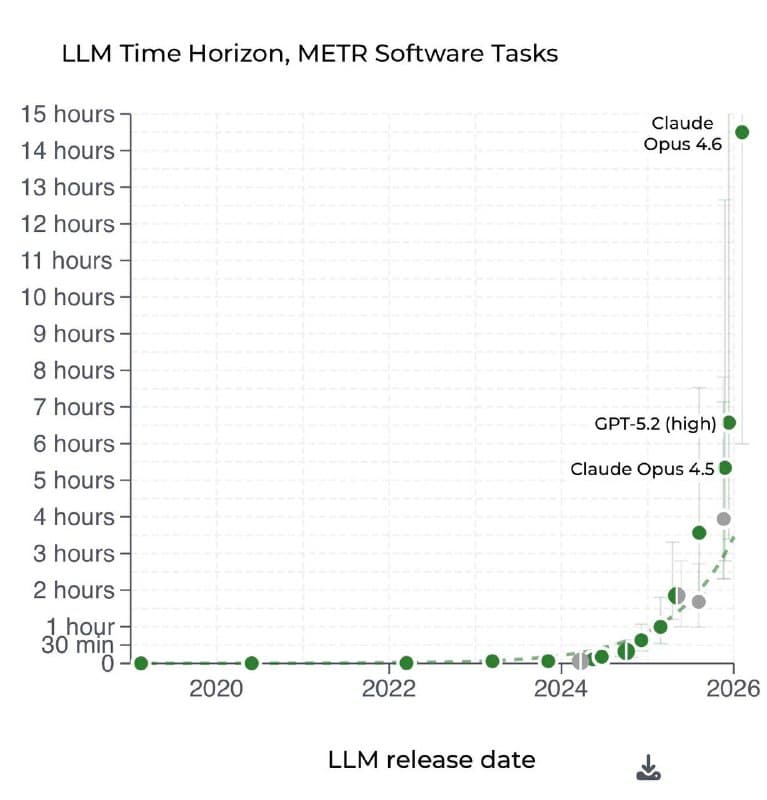
Dario Amodei said it in a May 2025 interview with Axios. He is the CEO of Anthropic and one of the loudest voices warning of the dangers of its technology. "Half of America's entry-level white-collar jobs will disappear within five years. Let's stop sugarcoating it."
Yann LeCun fired back on X in April 2026. He is Meta's former chief AI scientist, a 2018 Turing Award winner, and one of the three godfathers of deep learning. "Dario is wrong (jobs won't decline nearly that much). He knows nothing about how technological revolutions affect labor markets. Listen to economists, not AI experts."

They look at the same models. The same benchmarks. The same GPT, the same Claude, the same capability curve. One sees a cliff. The other sees a tractor.
Is Amodei right? The paper published by Erik Brynjolfsson's Stanford team in August 2025 is titled "Canaries in the Coal Mine." Since late 2022, entry-level employment among 22- to 25-year-olds in the occupations most exposed to AI fell by 13 percent. Employment among older workers in the same occupations rose by 6–9 percent. Take out one age group, and everything else is unchanged. The ladder is still standing. You just can't climb it. The ladder stands outside a building, and the building is disappearing.
Consider a new hire in Seoul. Twenty-six, a graduate of one of the SKY universities, six months as a consulting intern, three months since signing a permanent employment contract. His work consists of draft financial models, industry research summaries, and first drafts of slides. Claude does all of it. Faster, more accurately, without even the cost of coffee. If he is lucky, he won't be laid off. But there is no need for the next incoming class.
A question has begun circulating in recruitment interviews. "Did you do this research yourself? Did you use Claude?" Say you did it yourself, and you're inefficient. Say you used Claude, and you're replaceable. Faced with a question that has no right answer, many can only smile bitterly.
Internships open up now and then. Since AI does what interns used to do, interns drift through the things AI cannot do: coffee runs and emotional labor. Twenty-somethings with nowhere to go pour into graduate school. Schools still teach a curriculum from the 2010s. Their students will walk out into the job market of 2030. People walking precisely with the wrong map.
The top 10 percent direct AI. The bottom 50 percent do physical work AI has yet to reach. The middle is a vacuum. A quiet wind blows where offices once stood. This is Amodei's world.
Then is LeCun right? When the tractor arrived, 90 percent of farmers were pushed out of the fields, but cities rose in their place. The term office worker was invented. One generation left the fields, their children went to factories, and their grandchildren sat in offices. Three generations, ninety years of cushioning. Now we have to change three times within a single generation. The wisdom a father can pass on to his son disappears. Technology erases the authority of age.
Imagine a new hire in 2030. His job title is not in today's dictionary. AI coordinator, synthetic data editor, agent supervisor. He directs ten agents at once. In a day, he handles as much work as a team leader did in 2020. His résumé gives his degree one line and his GitHub commit graph two pages.
New jobs will emerge. But the way in will not be the same. In the past, a university degree was the ticket. In the new world, time spent working hands-on with AI is the key. Those who ran GPUs at home and had parents who bought them API credits get ahead. For the first time, the egalitarian promise of public education collapses completely.
The gap in these new professions grows wider still. Class does not disappear. It changes clothes. The disappearance of the middle is the same as in Amodei's world. What changes is the unit of class. From money to time. For those who direct AI, a day has 48 hours,
or more. For those who do what AI tells them, 24 hours. For those doing physical work AI cannot reach, twelve hours in the prison of a shift. The density of a day divides the classes. Poverty shifts from a question of money to a question of time.
Their predictions seem opposed, but the landscapes they arrive at look alike. In March 2026, the US unemployment rate was 4.3 percent. Still a long way from Amodei's projected 10–20 percent. LeCun's optimism has not been proven either.
The more important question for us is not how many jobs will remain. When the meaning of work changes faster than people can adapt, what do we hold on to as we define ourselves?
There was a time when a job was an identity. I am a lawyer. I am a journalist. I am a doctor. That one sentence explained each of us. Now AI writes the lawyer's briefs. It writes the journalist's articles. It makes the doctor's diagnoses. Am I a lawyer who does whatever AI cannot? A lawyer who uses AI? Someone who used to be a lawyer?
People fall apart not when they lose their abilities, but when they lose meaning. The moment I look for the part of me that AI cannot replicate, I tie my identity to AI's capability curve. Every time a new frontier model comes out, I get smaller. In the age of the tractor, you could say for certain: I am no longer a farmer. This time, even that diagnosis is difficult.
The person I am in March cannot imagine the person I will be in June. The half-life of identity keeps shrinking. If Picasso spent decades moving from one style to the next, now I have to discard myself every quarter.
Humans are, by nature, creatures of forgetting. For beings who forget yesterday's awkward self and are reborn as today's self, forgetting was not a flaw but a freedom. AI does not forget. The prompt I wrote last year, the draft I thought I deleted two years ago. Somewhere, they remain in a log. The half-life grows shorter, but the shelf life becomes eternal. The last generation with the right to forget is growing old now.
So in a society of shrinking half-lives, people cling to identity all the more. Social media bios keep getting longer. MBTI, musical tastes, personality test results. Glue meant to hold together a rapidly evaporating self.
The axis of time will be shaken. Will future generations understand what the Monday morning commute meant? The rhythm of a day, a week, a year. Take work away, and time returns without shape. Beyond freedom lies weightlessness. Six months on a space station dissolves 1–2 percent of your bone mass. In time without gravity, the bones of the self dissolve too.
The problems that will surface in Korea are more painful still. This is a country that has sorted people through exams. The college entrance exam, civil service exams, higher civil service and professional exams, corporate recruitment. At its peak, 300,000 people a year devoted themselves to civil service exams. Korean exams defined people by how well they could memorize. They did not ask what people could do.
AI gets perfect scores on those exams in an instant. The people lined up before a broken sorting machine are still waiting their turn. Study hard, get into a big company, and hold on until retirement. The script from our parents' generation is unchanged, but the stage is gone.
Many people cannot introduce themselves without a business card. It is also why retired fathers age so quickly. When the business card disappears, the person inside it folds too. The retired father's five years now become the new hire's five years. When we had business cards, we outsourced our selves, letting our titles speak for us. Now we have to say those words ourselves. To someone who has spent a lifetime living under someone else's name, their own name is a strange foreign language. The moment they try to pronounce it, their mouth stops. That silence is the quietest scream of our time.
Whether it is Amodei's scenario or LeCun's, it asks the same thing of us. What remains where work has disappeared?
A job has been the first sentence of a self-introduction for only a few hundred years at most, since the Industrial Revolution. It was a brief exception, one percent of human history. In agrarian societies, people explained themselves through land and family, not jobs. I am a Kim of the Gwangsan clan. A new era is not arriving. An old question is returning.
How do I explain myself through something other than a job?
No one yet knows what that something is. Not a game of finding work AI cannot do, but finding a self for whom AI's existence does not matter. Not outside the capability curve, but somewhere with an entirely different axis.
Each of us has to find it. Schools cannot teach it. It cannot go on a résumé in its existing format. We all have to wrestle with the question our time has posed.
Even now, somewhere, a twenty-six-year-old is writing a résumé. Not knowing whether it will be read by a person or by AI.