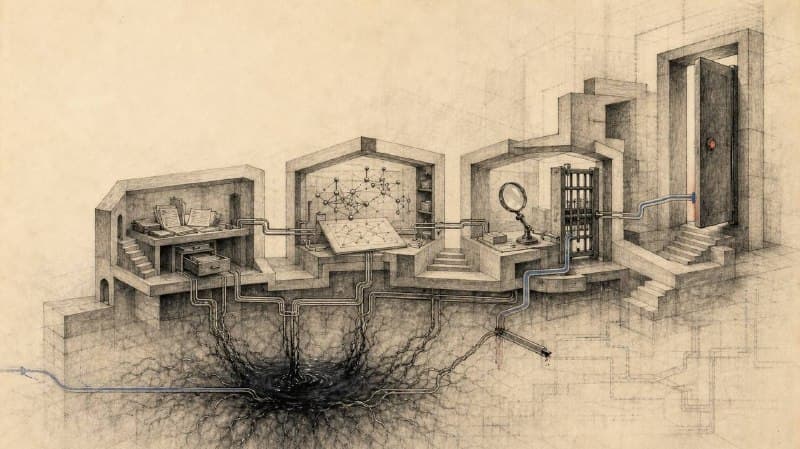
There are moments after waking from a nap when you feel like a different person, even though you are the same person. Your body is unchanged, but the heavy things have settled to the bottom, and there is space in your head that was not there before. Neuroscience calls this the restoration of synaptic homeostasis. Sleep downscales the neural networks overloaded during the day, reducing overactivated synapses to an appropriate level and allowing the brain to recover the space it needs to take in new information.
A study in ibroneuro Reports (2025) showed that even a short nap can restore damaged working memory at the fMRI level. There is a more interesting mechanism. When you enter NREM sleep, the deep sleep in which you do not dream, the brain undergoes slow oscillations and simultaneously coordinates three electrical rhythms: slow electrical waves moving across the entire brain, sleep spindles (short electrical pulses that lock memories into the cortex), and hippocampal sharp-wave ripples (signals through which the hippocampus replays the day’s experiences at high speed). When these rhythms line up, memories temporarily stored in the hippocampus are transferred to the cortex. Memories are not being stored so much as being relocated to a more stable place.

A study published in Cell (2024) found that during NREM sleep, norepinephrine oscillations periodically constrict the blood vessels, driving the glymphatic system (a cleaning system found only in the brain) to pump cerebrospinal fluid into the brain. While you nap, your brain is literally washed with cerebrospinal fluid, physically removing the metabolic waste that accumulated while you were awake. Sleep is cleaning. More precisely, it is distillation. It is a technique for increasing density not by adding, but by removing.
Compaction in AI agents works on exactly this principle. When a long buildup of conversation is compressed, only what matters remains and the rest settles out. Information does not disappear. It is rearranged into a form that can operate more precisely in less space. The relationship between context length and model performance is not linear. Once a certain threshold is crossed, the attention mechanism, the system that calculates which information the model should focus on, becomes distributed across past tokens, and the quality of the response to the question at hand substantially declines.
Just as a rocket must boldly separate the spent stages once combustion is complete to escape the atmosphere, compaction is not giving up but accelerating. You cannot carry the entire territory with you, so you make a map that keeps only the essential terrain. The lighter the map, the farther you can go.
That is why naps matter. Distillation happens twice a day. When a nap clears away the morning’s noise, the afternoon effectively begins with a new context.
When the Industrial Revolution made clocks universal and continuous labor a virtue, humanity began forcing the day into one long session. It is no different from an engineer extending the context window to its limit and asking why performance has declined. A nap is not simply feeling sleepy. It is a signal that your brain has detected memory fragmentation and is requesting garbage collection. Ignore it, and you get a runtime error.
Spain’s siesta, China’s wǔshuì, Japan’s inemuri. The fact that every civilization institutionalized naps was probably not an expression of laziness, but an old intuition about cognitive efficiency. True productivity does not lie in maintaining consciousness for a long time without interruption. It lies in making yourself clear again at appropriate intervals. The body knew before civilization did that forgetting is not deterioration, but refinement.
So I am not wasting time by napping. Twice a day, on a set schedule, I am simply rebooting my cognitive runtime, compacting fragmented memory, running the glymphatic garbage collector, fluffing the noise tokens in the attention layer, and booting back up with a new context window.