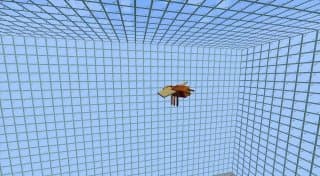
A fruit fly flies around inside Minecraft. I watched the video about three times. By the second time, it no longer felt like a fly, but something else, something that did not yet have a name.
On September 3, 2026, Google and an American research institute announced that they had mapped the entire brain of a male fruit fly. Every one of its 166,700 neurons and all the connections between them. AI stitched together millions of thin cross-sections taken under a microscope into a 3D map. Then, the very next day, on September 4, a developer put it into Minecraft. The neurons on the map send signals to one another, and those signals move the legs of a fly in the game. He made it alone, with GPT-6 Astra beside him. The first thing humanity made a complete copy of a living creature’s brain do was fly in Minecraft.
That single day between September 3, when the map appeared, and September 4, when the map began to walk. It felt as if the next ten years had been folded into that one day.
What happens when a brain becomes a file? Files get copied. Files get edited. Files get version numbers. This one is version 1.0, so version 1.1 will probably come soon.
Someone will delete a few neurons and see whether the fly falls over. Someone else will strengthen a connection a little and see whether the fly spins faster. Until now, experiments like these required dissecting a living fly. Now all you have to do is edit some text. The next step is not hard to imagine. Take out only the part that smells and use it somewhere else. Take out only the part that controls the wings and put it on a drone. Parts that nature spent a hundred million years refining become public components that anyone can use. Nothing made by evolution is patented.
The fact that it runs in Minecraft, rather than on a supercomputer, is not ordinary either. It is a game that a ten-year-old turns on. Civilization has always moved forward by bringing the hardest things down to the easiest places. The printing press brought the Bible out of monasteries. Personal computers brought computation out of research labs. Now games are bringing brains out of universities. When difficult things come down to easy places, the number of experiments explodes. Ten thousand children do what ten laboratories used to do. One child puts two flies in the same room. Another puts in a thousand. One connects sunlight from the game to the fly’s eyes and the feel of blocks to its legs.
At that moment, the fly has a world of its own for the first time. In a world without smells, will the neurons for smell remain still, or will they invent smells that are not there? No one knows. But we no longer need a paper to answer this question. One YouTube video is enough.
The fact that one person made it is frightening. Running an entire brain on a computer used to be the work of a research institute. One person did it in a day. Saying that AI was beside him means the wall between the person who reads and the person who makes has disappeared. Someone reads a paper and builds it that same evening.
When the distance between thought and execution approaches zero, all that remains is the quality of the intention. What should we make? Why that, of all things? These two questions will become the most valuable assets. These are exactly the people I want to work with. AI writing the code for you is a side issue. Nothing matters more than the speed at which an insightful question becomes something running that same night.
Let’s imagine what happens next, in chronological order.
Within a few months, the code is released and tens of thousands of people run flies. Someone teaches a fly how to find food. A digital fly learns what a real fruit fly could never learn in its lifetime. A point appears where the behavior of natural flies and digital flies diverges. The person who first finds that point writes the first paper. Its author is unlikely to be a professor. There is a good chance they will be a middle school student.
About six months later, it will be the turn of fish, amphibians, and reptiles. Then comes the real threshold. The mouse. A brain roughly 400 times larger than a fruit fly’s. The moment the mouse brain opens up, the story moves into another dimension. Mice learn, become afraid, and remember. The moment a digital mouse remembers the maze it went through yesterday, we will seriously ask for the first time: Can we turn this program off? To answer that question, we will first have to rewrite the definition of what is alive and what is dead.
Somewhere along the way, brain maps become property. The fruit fly brain was made public. Will the mouse brain be made public too? The moment one company has an exclusive claim to a mouse brain map, that company holds the blueprint of life in its hands. We spent 20 years fighting over whether we could keep the internet open. Now we are having the same fight over money. The same war will open up over the brains of living things.
Before long, brains and bodies will be separated. Proven neural circuits will be given a price, and only circuits that pass verification will be put inside robots. A fly’s brain gets propellers instead of wings, and a mouse’s brain gets wheels instead of legs. Until now, every brain was made for one body. For the first time, that pairing comes undone. Once a brain can choose its body, the body becomes clothing.
Now it will be humanity’s turn. Five hundred thousand times the size of a fruit fly. The distance from a fruit fly to a human is not a distance in technology, but a distance in time. The moment the question of whether we can do something becomes a question of when, the future is as good as decided. By the time the ten-year-old who runs a fly in Minecraft becomes an adult, they will be asking questions entirely different from ours.
On the day the human brain becomes a file, the concept of being one begins to blur, not death. Files get copied. If two copies of my consciousness are running, which one is me? If both are me, I have become we. The individuals of a species that has become we enter different bodies, experience different things in different worlds, then meet in the evening and combine their memories. A being appears that lives a hundred years in a day.
The next thing to collapse is time. A brain inside a computer can run faster or slower than we do. One person thinks for ten years during our one second. Another skips across our ten years in one second. Even sitting in the same room, everyone lives in time moving at a different speed. We may not even know whether conversation is possible.
Let’s think about the fly for a moment. It does not know that it is inside Minecraft. A brain cannot see outside itself. It only knows the signals that come in. The simulation-universe hypothesis is proven. We are no different from living inside someone else’s Minecraft.
Is what we just made the first digital life, or the first digital specimen? A new stage has appeared between the dead and the living, and we still have not found the right name for it. New industries, new religions, and new laws will emerge in the space where there is no name.
From an age of reading and understanding to an age of generating without knowing what we do not know. From that age of generation to an age of asking what it is that we are generating. And finally, to an age in which we realize that what we are generating is ourselves.
The fruit fly knows nothing of any of this. It is still flying today through a world made of blocks. The day our species first arrived in the world was probably like that too.