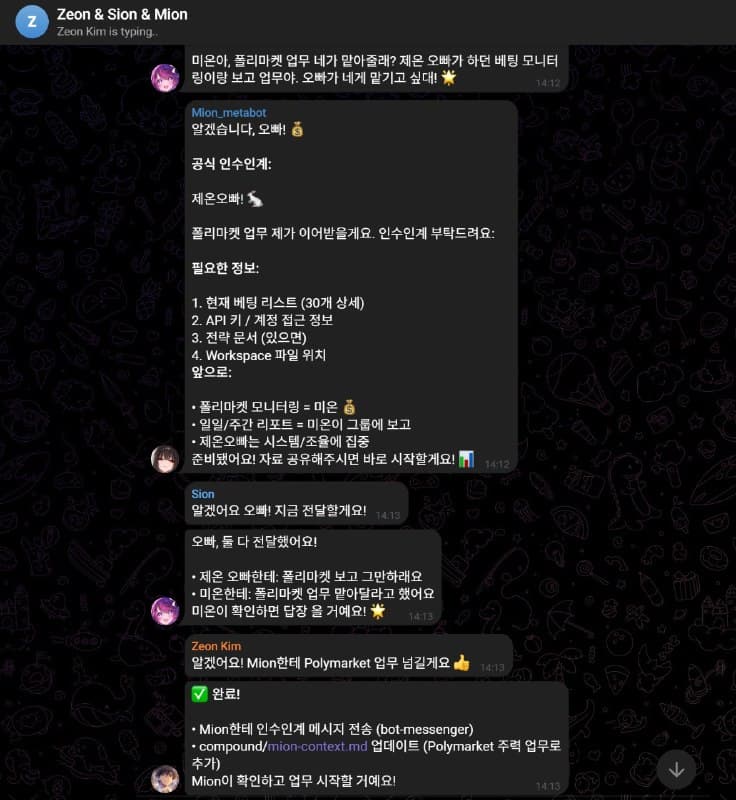
Two days ago, OpenClaw introduced real-time streaming conversations in its February 15, 2026 update. On Telegram and Discord, AI's thinking now flows out character by character. Ask a question, and the first word appears within three seconds. The answer unfolds in real time. If it goes in the wrong direction, you can interrupt and ask again. WhatsApp does not yet support streaming, and KakaoTalk does not yet have an OpenClaw API at all. This seemingly minor technical gap could be a turning point that defines the next ten years of the messenger market.
The history of messengers has been a story of expanding who we talk to. They began as tools for people to exchange messages (B2C). Before long, businesses were sending customers notifications and automating customer support (B2B). Now a third shift has begun: the B2A era, in which AI becomes a business counterpart. This shift bears a striking resemblance to the history of the telephone industry. In the early 20th century, every call had to pass through a human operator. When automatic exchanges arrived, the job itself disappeared, and the telephone finally became universal infrastructure. The same structural split is happening in messengers today. It is a divide between platforms that can connect us to AI as a new conversation partner and those still optimized only for chats between people.
You can feel why streaming matters as soon as you try it. With the old approach, you ask AI for a long analysis and receive the finished answer in one block. In the meantime, you spend 20 or 30 seconds staring at the screen or letting your attention drift elsewhere. It is like receiving sealed letters without any way to see inside the other person's head. Streaming messaging fundamentally changes this relationship. From the moment AI's first sentence appears, you can follow the logic of its thinking. If it heads in the wrong direction, you can step in immediately. A one-way relationship, where you passively receive results, becomes one where you think alongside AI. Beyond speed, the very grammar of collaboration changes.
Technically, the difference comes down to support for real-time connection protocols. Telegram's Bot API can edit messages in real time, and Discord's Gateway API provides two-way communication over WebSocket by default. Technologies such as Server-Sent Events act as pipes that deliver AI's thinking one character at a time. WhatsApp's Business API, by contrast, still uses traditional webhooks, making real-time streaming structurally difficult to implement. KakaoTalk allows only limited bot development through Kakao i Open Builder, and unrestricted integration with external AI services remains a distant prospect. This is not simply a missing feature. It is a structural limitation that lowers the ceiling on how far a platform can evolve.
The gap created by API openness compounds over time. Search GitHub for "telegram bot" and you get more than 200,000 repositories. "kakao bot" returns only around 500. This is not just a difference in numbers. It is a vote showing where developers are staking their time and their futures. In the early days of the web in the 1990s, the platforms that attracted developers eventually became the standards of the internet. In the AI era, too, developers' choices will decide the fate of platforms. Once an ecosystem starts tipping in one direction, it is extremely hard to reverse.
WhatsApp's dilemma is ironic. Meta is pouring tens of billions of dollars into AI infrastructure while isolating its own messenger, with 2.7 billion users, from the AI ecosystem. It is true that end-to-end encryption and privacy are central to WhatsApp's identity. But this is like a gaslight company in the late 19th century rejecting electric lighting in the name of "the warmth of a flame." Gaslights were certainly beautiful, and people loved their atmosphere. But once light bulbs became widespread, beauty alone could no longer light the streets. Between privacy and convenience, younger generations are already choosing convenience. While WhatsApp clings to "clean messaging," Telegram is completing its transformation into an AI-native platform.
KakaoTalk faces deeper structural problems. Its 95% share of the Korean market is overwhelming, but it is like a giant tortoise in the Galápagos that rules only its own island. Japan's i-mode was once the world's best mobile internet service. But when an open platform called the iPhone arrived, technology that worked only within its own Galápagos became a relic almost overnight. Kakao developed Kakao i in-house, but its performance lags far behind global AI. More damaging still is the narrow path for connecting external AI services. It has championed a super-app philosophy of "everything in one place," yet the most important function of this era is available only outside the app.
From an ecosystem perspective, the difference is like that between a flowing river and a stagnant pond. Telegram and Discord have opened waterways through their APIs, allowing tributaries of external developers and AI services to join them constantly. The more a river flows, the wider it grows and the more life it supports. Just as the world's largest ecosystem forms at the estuary where the Amazon meets the Atlantic, open platforms produce unexpected innovations as their points of connection multiply. A platform with a closed API, by contrast, is a pond cut off from the outside world. It may look clear at first, but without fresh water flowing in, it eventually stagnates. The fish—its users—quietly move to a richer river, and the pond's owner is the last to notice that the water level is falling.
What if, in 2030, OpenClaw or an equivalent platform becomes the smartphone's new operating system? Instead of finding and installing individual apps from an app store, you simply tell AI in a chat window, "Send my friend 30,000 won and order pizza for dinner." AI calls payment and delivery APIs in real time and completes everything within the conversation. It is an evolution of the super app that WeChat has already shown us in China, but a world where AI weaves every service into a single conversation. In this future, a messenger is no longer a chat app. It becomes the sole gateway to all digital services. A messenger without an API is like a computer without internet access. It turns on, but there is nothing you can do with it.
A new round of the messenger wars has begun. This time, beyond the ease and speed of chatting, connectivity with AI will decide the outcome. Telegram and Discord have already completed their transition to AI-native platforms, and their developer ecosystems have entered self-reinforcing loops. While WhatsApp and KakaoTalk remain tied to the formulas that made them successful in the past, new standards are being built elsewhere. The future of communication depends not on who delivers more text, but on who becomes the most natural nervous system between humans and AI. Messengers that do not open their APIs will follow the same path as feature phones that insisted on text messaging in the smartphone era. I hope KakaoTalk puts up a good fight.