Voices

Korea–Japan Entertech Forum AI Is Changing Who Owns Content

Panel Discussion

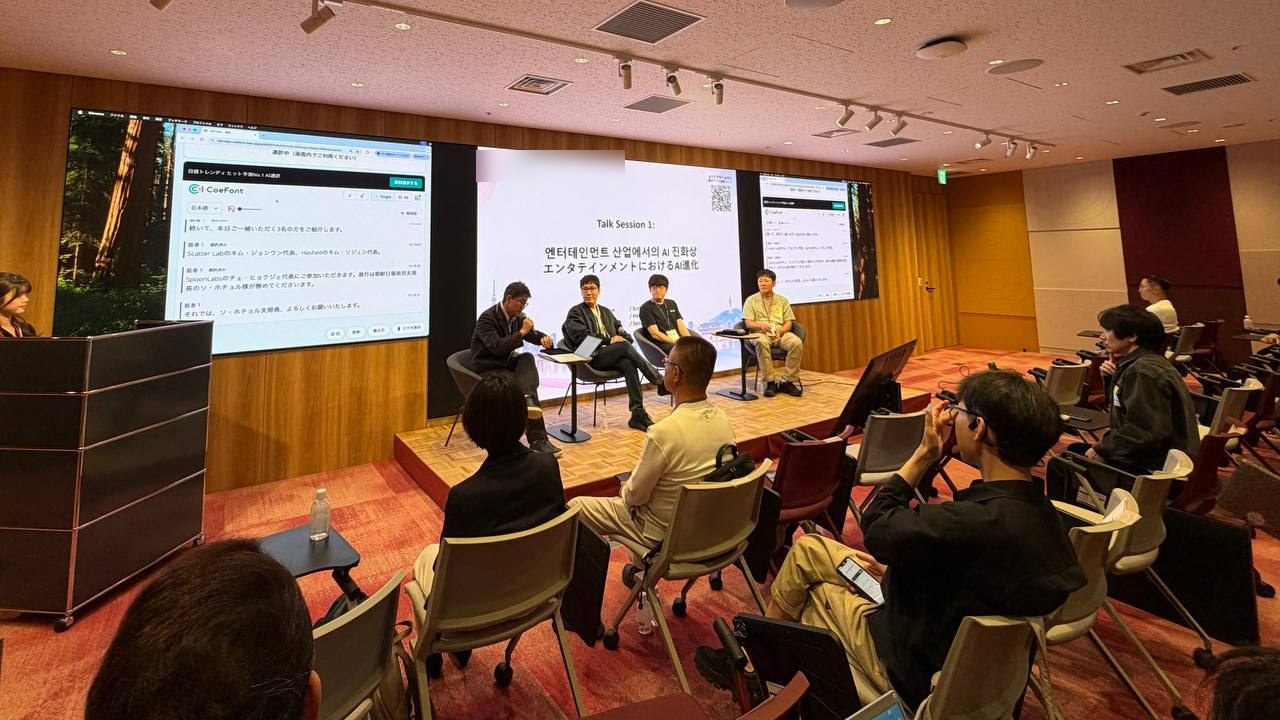
The stage for Session 1 of the Korea–Japan Entertech Forum. Four people are seated onstage, with “Talk Session 1” and “The Evolution of AI in the Entertainment Industry” displayed on the screen.

This is a record of Session 1 of the Korea–Japan Entertech Forum, “The Evolution of AI in the Entertainment Industry,” held in Shibuya, Tokyo, on October 23, 2026. Scatter Lab CEO Jongyoon Kim, Spoon Labs CEO Hyukjae Choi, and Hashed CEO Simon Kim discussed how AI is changing power structures and production costs in the content industry, the value of IP, and the potential for collaboration between Korea and Japan. The panel was moderated by Ho-cheol Seong, Tokyo bureau chief of The Chosun Ilbo.

Format
PANEL
Structure
44 TURNS
Speakers
4 SPEAKERS
00 CARROT CAVE INSIGHTS

CARROT CAVE INSIGHTS

About this record: This record is based on an automated transcript of Session 1 (16:20–17:11), with speakers identified and sentences edited for readability.
  1. As AI generates content in real time, control over the story is shifting from creators to users. Jongyoon Kim predicted that IP that resists this shift will be at a disadvantage, while IP that embraces it will continue to find new life.
  2. AI short-form dramas are made by first testing the market with productions costing around $10 per minute, then gradually moving up to higher production tiers. Citing his company's data, Hyukjae Choi explained that viewers open their wallets based on how entertaining something is, rather than how it was made.
  3. Just as quartz reshaped the watch industry, AI is changing how content is produced, but IP retains its value. Whether to open IP up to AI production remains the owner's decision, and how quickly that decision is made will determine who takes the lead next.
  4. As the price of utility approaches 0, value becomes concentrated in IP. Simon Kim presented trading card games (TCGs) as a superior alternative to the art market, and tokenization as a way for fans to become shareholders in IP.
  5. Japan has a legacy of original IP and animation, while Korea has an ecosystem that rapidly experiments with AI. The panelists agreed that collaboration between the two countries would offer an important opportunity in the competition over IP in the AI era.

Sources and Editorial Principles

  • Date and time: October 23, 2026, 16:20–17:11, Shibuya, Tokyo
  • Ho-cheol Seong: Tokyo bureau chief, The Chosun Ilbo; moderator
  • Jongyoon Kim: CEO, Scatter Lab; Zeta
  • Hyukjae Choi: CEO, Spoon Labs; Spoon Radio, Vigloo Studio
  • Simon Kim: CEO, Hashed
  • Structure: 7 chapters, 23 topics, 44 turns
  • Editing: Habitual speech patterns and repetition have been edited out, while preserving the intent of each statement and the strength of its claims.
CHAPTER 1

Meet the Panel

5 topics · 7 turns

01

Panel Introductions and the Moderator's Opening Question

Ho-cheol SeongHello. I'm Ho-cheol Seong, Tokyo bureau chief of The Chosun Ilbo, and I'll be moderating this session. Our topic is “The Evolution of AI in the Entertainment Industry.” We'll be discussing how AI is changing the entertainment and content industries with three people who are experimenting firsthand at the forefront of that change.

Let me introduce our three panelists today: Jongyoon Kim, CEO of Scatter Lab; Simon Kim, CEO of Hashed; and Hyukjae Choi, CEO of Spoon Labs.

First, I'd like each of you to introduce yourself and your company. Please also share your thoughts on how AI is changing the content industry right now. Let's start with Jongyoon Kim.

02

Zeta: Generating Stories in Real Time

Jongyoon KimHello, I'm Jongyoon Kim, CEO of Scatter Lab. We make an AI service called Zeta. A lot of people use Zeta in Korea, the United States, and here in Japan as well. We're always grateful to our Japanese users. Let me first explain a little about what Zeta is. People who aren't familiar with it usually think of it as an AI chat app. Some call it character chat or an AI companion, and many see it as an app for chatting with an AI girlfriend or boyfriend.

That's not how we see Zeta. Zeta is an interactive entertainment app where AI creates new content in real time in response to what users say and do. Long term, we're looking to companies like YouTube and Roblox as models for what we want to build in interactive entertainment.

Ho-cheol SeongThank you for introducing your company. Could you also say a little about how you see AI changing the content industry?

Jongyoon KimI think everyone here would agree that AI is going to change everything. Entertainment will be no exception. We're particularly interested in interactive entertainment. When people hear that term, they usually think of games, but we believe a new category of AI-native entertainment, like Zeta, will emerge beyond games. It's been about 40 years since games arrived, and we see last year and this year as the years when a new form of interactive entertainment was born.

03

Spoon Labs Takes the Plunge into AI Short-Form Dramas

Hyukjae ChoiI'm Hyukjae Choi, CEO of Spoon Labs. Our company is about 14 years old, and in Japan we're best known for a service called Spoon Radio. 2 years ago, we saw a huge opportunity in the short-form drama industry and launched Vigloo. We now run both an audio platform and a short-form drama platform, and more than half of our total revenue comes from Japan. So it's the market I put the most effort into.

When AI technology came along, we decided to be the most active and the fastest at making content with it. We now produce more AI short-form dramas than any other company in Korea. I'll get to whether they're generating revenue later.

One thing my mentors have told me is that when a wave comes, you shouldn't fight it—you should ride it. We're working really hard to ride this one. We use a lot of solutions from video AI companies and big tech, so we collaborate with partners in China and travel there often. We're experiencing firsthand just how quickly content production is changing.

People who have been making content for years understand intellectually how big this shift is, but they haven't acted on it yet. I believe the more slowly the established players move, the bigger the opportunity for companies like ours that jump in with new technology. Today, I'll talk about how our company is navigating this transition.

04

Hashed's Experiment: MODHAUS and tripleS

Simon KimHello, I'm Simon Kim, CEO of Hashed. You probably know Hashed as a blockchain investment firm. Over the past 8 years, we've invested in around 150 companies across blockchain, AI, content, and entertainment. We started with blockchain and began expanding into AI and content 2 years ago. These days, I'm particularly interested in the intersection of frontier technology and content.

Beyond investing, we've also consistently done about one venture-building project a year—meaning we build companies ourselves. One of them is MODHAUS, a K-pop label we founded in 2021. It runs idol groups whose fans participate in governance, and it manages tripleS, a 24-member girl group with the largest lineup in Korea.

Once we started operating, we found that spending per user was about 3–4 times that of other labels with similar audience sizes. All 24 members perform together and release an album just once a year. For the other albums, fans vote to form units of 8 to 12 members. We made voting rights and NFT-based photo cards available for fans to buy in the app, and those generate a lot of revenue.

I think K-pop isn't generating revenue that matches the loyalty of its fans. No matter how much someone loves BTS or BLACKPINK, it's hard for them to spend a lot of money unless they buy a huge number of albums. In gaming, though, a single person might spend 100 million won. The biggest spender on our app is a 43-year-old woman living in Canada. She has actually come to concerts, too, and has spent well over 100 million won in the app. That's possible because the system lets people participate in governance, get real value out of it, and become more loyal in the process.

Photo cards are a major source of revenue in K-pop, but they also create a lot of problems. People buy multiple copies of the same album to get randomly included photo cards, then keep the cards and throw the albums away. Most people don't even have CD players at home these days, do they? Ultimately, what fans really want is the photo card, not the album. So we turned photo cards into digital assets that fans can trade and play with in a digital space.

05

How Quickly Countries Adapt, and How Value Is Concentrating in IP

Simon KimThat's how we're experimenting in the entertainment industry. Director Jung Geun-woo from Morpio will also be presenting at the startup session later. They've built an engine that uses AI to produce high-quality animation at low cost, and they're partnering with various content companies and creating original work as well. I think you'll find the quality quite impressive when you see the demo.

But in meeting with various companies in Japan and Korea, I've heard a lot of contrasting feedback. Everyone says the quality is good. Now, I love Japan, but I felt that some of its long-established companies were being held back a little by this idea of craftsmanship. They tend to undervalue content that wasn't painstakingly made by people over a long period of time—content made well and cheaply with AI—or to turn away from it even though it clearly has a future. The more established the media or content company, the more deeply rooted that attitude was.

I think China is probably at the opposite end, with Korea somewhere in the middle. When Korean and Chinese content companies find the best technology, they take it straight to market, moving quickly to try things and experiment. So there are clearly ways Korea and Japan can complement each other. Japanese companies have originality and IP in the content industry, while Korea is seeing an ecosystem emerge earlier that experiments more boldly with AI technology. I hope today's gathering inspires both sides and leads to plenty of partnerships.

My view of how AI will change the world of content also explains why we're looking more and more at content within frontier tech. As you've probably noticed lately, you can now build utility services with a single click using AI. Not just Adobe products like Photoshop and Illustrator, but even tools like Figma are being reverse-engineered and made available for free. As a result, Adobe's stock price has fallen sharply, too.

As the price of utility services approaches 0 won, where will the value go? I think IP is one place. Pokémon cards don't lose value just because someone imitates Pokémon. The ecosystem simply grows. A son comes to love the Pokémon his father loved, building a fandom across generations, and the value of both the cards and the IP actually rises. AI will play a role in enriching these ecosystems, but I don't think it can create original content overnight. In the AI era, original IP may actually become even more powerful. What interests us most is bringing together the strengths of these two areas to create synergies.

CHAPTER 2

When the User Becomes the Protagonist

2 topics · 7 turns

01

TV Dramas, Games, and the Power Structure of Zeta

Ho-cheol SeongThe three of you are among the most proactive and advanced adopters of AI in content, at least in Korea. You may even be among the fastest in Asia. Let's dig a little deeper with each of you.

Jongyoon Kim, you used the word "interactive." I understand this isn't simply conversational AI, but character-based entertainment that users shape themselves. People here have worked on linear content like TV dramas and webtoons, where you create something and deliver it to an audience. But we're hearing that people spend 10 or 12 hours at a time on Zeta. What do you see as the fundamental difference that creates that level of immersion?

Jongyoon KimUltimately, I think the difference is who holds the power in creating entertainment. In traditional content, creative control belongs to the creator. In TV dramas and films, the director and writer decide everything about what story to tell and how to tell it.

Games give users a certain degree of freedom, too, but the game director is still in control. The director defines the world of the game and its boundaries. So I also see freedom in games as a kind of illusory freedom. You can't go anywhere the director hasn't built.

That power structure is different in Zeta. The content experience on Zeta is created jointly by three parties: the creator, the AI model, and the user. And the user holds the most power. We call them creators on Zeta, but they're really closer to people who prepare the ingredients for the content. They put together the worldbuilding information, the characters, and an opening event to set up a plot.

Which new characters appear and what happens next are determined as the user plays, supported by the AI model. You're creating and experiencing new content on the fly. The creator has almost no control over what happens after the starting point.

02

Power Shifts Toward the User

Ho-cheol SeongSo should we understand that immersion as people getting drawn into content because they've created it themselves?

Jongyoon KimI don't think users see themselves as creating content. Rather, I think they become immersed because, instead of following a path laid out by a creator, they can become the protagonist and determine their own fate.

Ho-cheol SeongThere are probably many people here who have been making traditional entertainment or who own IP. Does that mean AI will soon pose a threat to established creators?

Jongyoon KimI think it will depend on how they respond to this broader shift. There are two paths. IP owners and creators cherish the worlds and characters they've created like their own children. So when a user comes in and takes a character in a direction that diverges from the original setup—even if it isn't necessarily anything bad—they may feel uncomfortable.

Take Harry Potter, for example. In the original, Malfoy is a villain and Harry Potter is the protagonist. But if a user befriends Malfoy and plays by fighting against Harry Potter, the original author, J.K. Rowling, might feel uncomfortable. In that case, she would ban that kind of play.

I believe that in this new world, the power structure around content will be completely reshaped. Ultimately, the user is king. So those who try to block it won't fare well. On the other hand, if you let users recreate, rediscover, and interpret your worlds and characters in different ways, it can become an opportunity. Instead of linear content that's over once you've seen everything laid out for you, it becomes IP that's continually given new life.

Ho-cheol SeongIt sounds like you’re saying that, ultimately, the original creator’s mindset makes a crucial difference.

CHAPTER 3

The Cost and Speed of AI Short-Form Dramas

3 topics · 4 turns

01

Production Costs and Timelines by Tier

Ho-cheol SeongLet’s turn to Hyukjae Choi next. You said that Spoon Labs’ Vigloo Studio produces more AI dramas than any other company in Korea. You’re releasing short-form dramas made entirely with AI, not just in Korea but around the world. Specifically, how much does using AI reduce production costs and timelines?

Hyukjae ChoiEven before the event started, Bureau Chief Sung asked me whether AI content was a bit awkward and strange. The AI dramas that look that way are actually test videos we release to users around the world. They’re not content we made to generate revenue. So you shouldn’t look at those and conclude that AI video is low-quality. We put them out very cheaply and quickly to see whether viewers respond, and if they do, we move up the production tiers step by step.

Let me give you some rough benchmarks for costs. In China, they have pricing tiers laid out like a menu. They’re usually divided into A, B, and C tiers; we don’t work with the D and E tiers below those. Tier C costs $10 per minute to produce. Those slightly awkward, AI-looking videos you see so often are the $10 ones. Tier B is the quality level most commonly used for short-form dramas, at about $50 per minute.

The highest tier, A, is quality suitable for cinemas, streaming platforms, or widescreen TV, and costs 1.5 million–2 million won per minute. You can make 60 minutes for 120 million won. It’s at a level where the people in this room wouldn’t be able to tell whether it was made by people or by AI.

The reason we don’t focus on tier A is that selling a lot at a low price makes much more commercial sense. We make tier A productions as flagships to show what we’re capable of. We’re currently preparing a theatrical release based on Japanese IP ourselves. But the actual business is doing perfectly well with tiers C and B.

The production timelines will surprise you even more. At tier C, the $10-per-minute level, it takes just 5 days to make a 60-minute drama. Tier B takes 3 weeks, and tier A takes 8 weeks for production alone, assuming you already have a script. That’s why so many dramas are pouring out.

02

Viewers Care More About Entertainment Than How It’s Made

Hyukjae ChoiLike Zeta, our main markets are Korea, Japan, and the United States, and we run our own platform used by millions of people worldwide. So we can see in the data whether AI dramas actually sell. And here’s the most unsettling part. Viewers don’t care whether people filmed it or AI made it. If the story is entertaining, they’ll pay to watch.

Production costs have fallen to between one-fifth and one-tenth of what they were, and production time is down to one-fifth as well. From a production company’s or platform’s perspective, there’s no reason not to do it. People ask who would watch AI content, but viewers have already started paying, and the distinction has disappeared.

So we decided to move quickly. When ByteDance’s Seedance 2.0 came out earlier this year, we tested it internally and decided we absolutely had to switch. Before that, 90% of our drama production was live action and 10% was AI, but we flipped that. Now we make 90% with AI and shoot only about 10% in live action.

03

History Repeats Itself: From Hollywood to the Quartz Crisis

Hyukjae ChoiOur business development team told me that history repeats itself, and it’s an interesting story, so let me share it. When Hollywood first started making movies, the Broadway theater world treated them like trash. They dismissed them, saying actors should perform onstage for an audience with their own voices, and that putting a performance on a screen was entertainment for the lower classes. Then movies took the lead.

After Hollywood became the center of the industry, television spread in the 1950s, and this time the film industry looked down on TV. They even campaigned against putting Hollywood content on television, but in just 10–20 years, their positions had reversed.

Later, during the transition from film to digital, masters like Christopher Nolan and Hayao Miyazaki also resisted, saying that if it wasn’t shot on film, it wasn’t cinema. But did the old ways disappear? No. They remained in the premium segment, while the mass market passed to companies that were quick to embrace the new technology.

Japan was also one of the first countries to experience this. In 1969, Seiko released the world’s first quartz wristwatch, turning the global watch market upside down. In Switzerland, which had dominated the world market, the number of watch companies fell from more than 1,600 in 1970 to fewer than 600 by the mid-1980s, while the industry’s workforce shrank from 90,000 to 33,000 by 1984. All because of a single component: quartz. Japanese companies like Seiko and Casio took the lead by flooding the world with reasonably priced watches, while Swatch rode that wave in Switzerland. Among the rest, high-end companies like Rolex and Audemars Piguet survived.

I think Japan’s content industry today is standing where Switzerland stood in 1969. That quartz component has now been released around the world in the form of AI, and other countries, particularly China and Korea, are using it to make watches in enormous quantities. I think you have to ride this wave to survive.

CHAPTER 4

IP Still Survives

2 topics · 4 turns

01

IP Owners Decide Whether to Use AI

Ho-cheol SeongThat brings me to a question about timing. Will we reach a point where animation, TV dramas, and movies are all made with AI? And if that happens, won’t China, which is already producing enormous amounts of content with AI, take it all?

Hyukjae ChoiWe think about that a great deal too. But ultimately, IP survives. Pokémon came up earlier. Whether Pokémon is made with AI is up to the IP holder. We’ve been asking countless IP holders in Korea, Japan, and the United States to open up their IP to us. We’ve contacted everyone from webtoon and web novel owners to famous Japanese game companies whose names you’d recognize immediately, but their initial response to AI production is negative.

Here’s the future I envision—not from the consumer’s perspective, but from a business perspective. If companies that own IP run into financial trouble or see their revenues fall, I think companies at the forefront of AI may be able to go shopping, so to speak, for that IP at very low prices. Conversely, IP holders that move quickly will be able to maximize the returns on their IP at the cutting edge of AI technology.

02

Resistance from Legacy IP Holders in Japan and the United States

Hyukjae ChoiJapan has an incredible wealth of IP. But in our experience, legacy IP holders in Japan and the United States are the most resistant to AI production. Korea is somewhat more open, because some companies feel that webtoons have given them another opportunity.

Ho-cheol SeongSo your view is very close to Jongyoon Kim’s: the future depends on the decisions of original creators and IP holders.

CHAPTER 5

How Content Makes Money

3 topics · 6 turns

01

TCGs as Assets and the Art Market

Ho-cheol SeongNext, let’s turn to Simon Kim. Here’s what I’m most curious about. Ultimately, content has to make money, doesn’t it? Earlier, you said that even with the same kind of K-pop idol group, blockchain helped increase spending per user by 3–4 times, and you also said that a craftsman’s mindset can hold you back. Can combining content with blockchain create new revenue models? Are there examples from overseas as well?

Simon KimIn the content market, we’re very interested in TCGs—trading card games—as an asset class. Hashed creates a lot of unusual funds, and we’re now setting up what may be the first institutional TCG fund.

TCGs have several appealing qualities. First, prices for blue-chip TCGs, including Pokémon, have been rising steadily every year. Second, their correlation with other assets is close to 0. Whether the global macro environment is shaky, a war breaks out, or the Nasdaq falls, they keep rising fairly steadily. That makes them very attractive as assets.

The art market is huge, and there are plenty of art funds. If you think about why the art market developed, people buy art once they’re comfortably making a living. People struggling to get by don’t buy expensive paintings. Korea’s sudden art boom came around the time of COVID, and just before that, a lot of apartments in the 70-pyeong range started coming onto the market, particularly in areas like Gangnam, Seongsu, and Yongsan. In Korea, around 35 pyeong had been the most common size—the so-called standard apartment size—but larger units were becoming more common.

I had a similar experience myself. When I moved into a bigger home, I suddenly noticed all these walls I’d never been aware of in a smaller place. You need paintings to hang on them. I’ve heard that the art market grows once per capita income exceeds $30,000. Art isn’t a practical necessity. You can make a living just fine without it. But once people’s practical needs are met, they start spending money and time on things that inspire them. Content and entertainment fall into a similar category.

02

Four Reasons TCGs Are a Better Alternative to Art

Simon KimI think TCGs—intellectual property turned into cards—are an upgrade on this art market. There are a few reasons for that.

First, they’re easy to understand. Unless you’ve studied art, it’s hard to know how much a painting is worth. If someone says a painting from 300–400 years ago is worth 10 billion won, that doesn’t really resonate with someone who hasn’t studied painting. But Pokémon fans can easily understand why a particular card is expensive. The rarity rating is printed right on the card, and limited-edition collaboration cards featuring popular characters just seem more fun—and actually sell for high prices. Far more people understand the worlds of Pokémon or One Piece than understand the history of a Van Gogh painting. That means there are far more potential buyers.

Second is accessibility. There are only so many paintings by famous artists, but new Pokémon and One Piece cards keep coming out, and you can buy one for a few thousand won. Pulling cards is fun, too. It has that gacha-style thrill, with uncertainty and game-like elements. Yet the most expensive cards can go for tens of billions of won each. This February, a Pokémon Illustrator card sold at a Goldin auction for about $16.5 million, roughly 24 billion won. One of the GPs setting up the TCG fund with me is the person who originally owned that card—a guy who’s something like UAE royalty.

Third is storage. Paintings are difficult to store, but once a card has been graded and sealed in a plastic case, you can carry it around in your pocket as long as you take proper care of it. That’s a good quality for an asset to have.

Fourth is inheritance. Tax and inheritance considerations are among the reasons wealthy people buy paintings. But which would be easier to pass down: a painting or a Pokémon card worth 10 billion won? Obviously, the card would be much easier. Apart from being able to hang it on the wall, show it off, and enjoy it at home, IP-based cards have quite a few advantages over art. I feel these cards are now starting to eat into the art market. It’s a great example of IP monetization.

03

Direct Investment in IP and the TCG Fund

Simon KimAnother way to invest in IP has emerged recently. In the past, no matter how much you liked Disney’s IP, you couldn’t invest in the IP itself. Even if you loved the Avengers, there was no way for an individual to invest in Iron Man or the Avengers series. But with blockchain came a mechanism called an STO—a security token offering—which makes it possible to tokenize products like films, TV dramas, and K-pop so individuals can invest in IP. It’s still experimental, but it’s becoming a major global trend. Technology is creating more ways to invest in the actual upside of the IP you love.

The photocards for tripleS follow the same logic. K-pop fans are already doing this with paper cards. Near a major idol concert venue, you’ll see fans sitting on mats, trading cards in person. There’s a limit to how much trading can happen offline. We made it possible to trade these globally using blockchain, and the cards we’ve issued have already been traded more than 50 million times worldwide. Going digital gives the IP itself value through blockchain, and creating a global marketplace for exchanging everything from TCG cards to celebrity photocards is driving more active trading.

Ho-cheol SeongA quick question: you’re setting up a fund that invests in Pokémon cards. How big will it be?

Simon KimIt’s an open-ended fund, so we plan to run it as an evergreen fund. The structure lets us keep buying good assets and realizing gains as their prices rise, then continue the cycle. I think we’ll launch with around 30–40 billion won.

CHAPTER 6

IP Tokenization and Investment Criteria

3 topics · 5 turns

01

Tokenization as a Capital Market Trend

Ho-cheol SeongWouldn’t IP owners be put off by the mention of blockchain? They might ask, “Why should we put this great IP on a blockchain?”

Simon KimI see it as inevitable once this connects with capital markets. Those who follow the blockchain industry may know that stock tokens for Korean companies like Samsung Electronics and SK hynix are already being traded on decentralized exchanges with 10x leverage. You’ve probably heard terms like “security tokens” and “tokenized securities” a lot. Almost everything in capital markets is being tokenized.

This is the direction capital markets are moving in. Liquidity improves, more people can buy things they couldn’t buy before, and they gain the option to participate in governance. Some IP holders may dislike it, but K-pop companies have actually started actively raising money from their fandoms through security tokens.

02

A Model Where Fans Become Shareholders

Simon KimThe relationship between fans and idols has traditionally been one-sided. Idols make music, and fans listen and spend money, but the profits go only to the agency and its shareholders. Why can’t fans become shareholders? You can become a shareholder in HYBE, but being a HYBE shareholder doesn’t make you a shareholder in BTS. As this relationship becomes tokenized, we’re starting to move beyond experiments and see actual products emerge.

There’s a makgeolli bar I know. Most restaurants have one owner, but this place has 100 owners, each with a 1% stake. Business is doing incredibly well. With 100 people who think of themselves as the owner, how could it not? They bring their friends and say, “This is my restaurant.” I think the same applies to idols. If I have a stake in a new idol group, I’ll feel more loyal and listen to them more. So I don’t expect established idols to tokenize; I think newly formed groups will do more of this kind of experimentation.

03

Investment Criteria in the AI Era

Ho-cheol SeongOne more quick question. Simon, you’re also one of the investors deploying the most capital in Korea. In this AI era, if you were investing in entertainment companies that use technology well, are there any key things you’d look for?

Simon KimFirst, they need to be using AI extensively and proactively. Another consideration is UGC—user-generated content. I think a company like Scatter Lab is a very good example. The question I ask most often is whether they simply produce and distribute content, or whether they are an open platform where participants can become the main characters or contribute to creating it.

CHAPTER 7

The Japanese Market and Korea–Japan Collaboration

5 topics · 11 turns

01

How Zeta Established Itself in Japan with a 40-Person Team

Ho-cheol SeongWe have 10 minutes left in the session. Let me ask a final round of questions. All three of you are here in Tokyo as leaders of Korean companies. I'd like to ask each of you about entering Japan and the potential for synergies through collaboration between Korea and Japan.

First, Jongyoon Kim. Zeta has established itself in Japan and is bringing in quite a lot of money every month. Could you take about 2–3 minutes to explain how you gained a foothold and how Korean and Japanese users differ?

Jongyoon KimI think it's genuinely difficult for a Korean startup to succeed in Japan. People often ask me why Zeta has done so well there, and honestly, I don't know the exact answer myself. But I do think it's much easier for AI-native products to cross language and cultural barriers.

Our team has only 40 people. But across Korea, Japan, and the United States, we have around 5 million monthly active users. We can run all of that with 40 people. We're a platform, and creators and AI produce an enormous amount of content, so we don't create any content ourselves.

In the past, webtoons, web novels, and games clearly faced high barriers to localization. But with a product like Zeta, localization happens on its own, in a sense. The AI models are trained separately in Korean, Japanese, and English versions. Local creators in each country make the content, and the people playing are Korean, Japanese, and English-speaking users. So when you look at the resulting content, the Korean content feels Korean, the Japanese content feels Japanese, and the English-language content feels like it comes from the English-speaking world.

For example, in the United States, stories about anthropomorphic characters like werewolves are hugely popular, and genres like stories set in Black ghettos are popular too. You'd hardly see those in Korea or Japan. How could we possibly know everything Americans like? But the people there create and play all of that themselves, so as a platform, we just need to provide good AI models and manage the ecosystem well, and the rest fills itself in. I think that's how we've been able to grow so quickly worldwide, even though we're a small startup even by Korean standards.

Ho-cheol SeongA 40-person startup is running Zeta. If you meet Mr. Kim during the networking session later, be sure to ask him how much they make per month. You'll be amazed. I asked him when we met a few months ago, and I was amazed too.

02

Japan's Chinese-Dominated Short-Form Market

Ho-cheol SeongNext, a question for Hyukjae Choi. China has essentially taken over short-form dramas. You may not know this, but even the English-language short-form dramas coming out in the United States are all made by Chinese people. In a market they've dominated so completely, you stand out as the Korean entrepreneur holding your ground. How do you view the Japanese market, and what potential do you see there?

Hyukjae ChoiFrom a business perspective, we're very interested because it's a market with strong purchasing power. For short-form dramas, the United States alone accounts for more than 50% of global revenue, and Japan comes next.

What's interesting is that if you rank the top 10 companies by revenue in Japan, 9 are Chinese, and the other one is us. Right now, Chinese companies are the ones getting Japanese viewers to open their wallets and taking home the money. And if you're wondering whether spending on short-form content is small, it's not small at all. It's growing tremendously, and as far as I know, in Japan it's rapidly growing to a level second only to games among in-app purchase categories.

In our experience, Japan is a market with very high standards for its own domestic content. When it comes to live-action dramas in Japan, Japanese viewers will pay to watch Chinese or Korean productions even if they're a little rough around the edges, because they're in a foreign language. But their standards for productions featuring Japanese actors speaking Japanese were incredibly high. I think that's characteristic of a country that produces a lot of content.

03

AI Is Lowering Language Barriers

Hyukjae ChoiWith the shift to AI, this has changed 180 degrees, and we see it as an enormous opportunity. We produce around 100 new titles a month, and 95% of them are in English. These are Koreans making content in English. That's because the quality of AI-generated English speech has become so good, and English offers the greatest upside when something takes off commercially. If it sells in the United States, you can then sell it in Europe too. Koreans write the stories, but now we can freely produce English-language content.

If the quality of English is 9.5 out of 10, Korean and Japanese are now at about 7. But the quality is improving enormously every 3 or 6 months. Chinese tech giants are driving this. Companies like Tencent and BytePlus come to us every month and say the quality has improved, so let's try making something. Then our Japanese team says, not yet, it needs to get better. And it keeps improving through that process.

I think Japanese will reach a level that sounds natural even to Japanese listeners in as little as 6 months, or within 1 year at the latest. Korean has improved a lot too. At that point, Korean companies, along with Chinese companies that churn out enormous volumes of content, will flood the Japanese market with content featuring actors who look Japanese performing in Japanese. I think that market share will then shift to Chinese or Korean companies that adopt AI quickly.

So I think both we and Japanese companies need to adopt AI technology quickly and proactively, whether that means pursuing a premium strategy or using existing IP to set ourselves apart. That's how we can differentiate ourselves amid the changes coming over the next 1–2 years.

Ho-cheol SeongIt's fine that China is doing well in short-form dramas. But I'd like to see China account for about 6–7 out of 10 rather than 9, with Japanese and Korean companies in the mix too.

04

Animation: The Kingdom of IP

Ho-cheol SeongFinally, Simon Kim. Those of you from Japan may not know this, but Simon is an exceptional thinker not just in blockchain but in technology more broadly, and a prominent voice of leadership in Korea's startup industry. He's also very interested in Japan. Across entertainment and AI technology, what do you think is the greatest synergy Korea and Japan could achieve?

Simon KimAs I mentioned earlier, I think Japan has a deep history of original IP. K-pop, K-dramas, and Korean movies all have original IP too, but I'm very clear on this. Animation is the king of IP. I'm sure people in Japan take pride in that too.

Most IP franchises worldwide that have generated more than 10 trillion won in cumulative earnings are Japanese. The two IP franchises with cumulative revenue exceeding 100 trillion won are Pokémon and Sanrio's Hello Kitty. Among the rest, too, Japanese IP has much higher cumulative revenue than American IP.

I really enjoyed the Hollywood movie The Odyssey too. But once I've watched it in the theater, that's it. I don't walk around wearing a T-shirt from the movie, play its games, or buy its figures. With novels and dramas, too, once the story ends, the life of the IP stops there. But with a well-made, top-tier animated work, the power of the IP keeps building. And I think more than 90% of the best IP today is Japanese.

I’m personally very close with Junkoo Kim, the CEO of WEBTOON, and with the head of PTJ Comics, Korea’s largest webtoon studio. Ultimately, everyone’s North Star is breaking into Japanese animation. The same goes for webtoons. As you probably all know, webtoon growth has stalled, but the moment a webtoon IP succeeds as an anime in Japan, its standing changes completely. IPs like Solo Leveling have brought in trillions of won. Those are numbers you simply can’t imagine from webtoons alone. That’s why, as I understand it, WEBTOON currently has more than 10 production committees running in Japan.

K-pop is the brightest stage in Asian pop, so people from Japan, China, and Southeast Asia want to come to Korea and debut as K-pop artists. In much the same way, the Japanese market plays that role in animation, the kingdom of IP. Right now, Japan is the stage where those dreams come true: you have to turn your IP into a Japanese anime, in Japanese, and make it a hit there for it to become an IP worth 10 trillion or 100 trillion won.
05

Japan’s Choice and a Proposal for Korea–Japan Collaboration

Simon KimBut will this opportunity remain Japan’s forever? The way things are made is changing completely. To use an analogy, everyone is moving from cash to credit cards and QR codes, while Japan still prefers working with pen and paper. Unless Japan’s industry moves beyond digital and adopts AI quickly, the new IPs of the future will be created outside Japan. And then, at some point, I think that place at the very pinnacle of IP—animation—and even its home base could shift to Korea or China.

Since China isn’t here with us today, I’d like to see Japan collaborate extensively with Korean companies that are rapidly putting AI to use. What I’m proposing is that we work together to preserve and expand Japan’s leadership in animation, the crown jewel of IP.

Ho-cheol SeongThank you. Please give all three of our speakers a round of applause.